

AI recruiter outreach is transforming how job seekers connect with companies and beyond. Instead of applying and waiting in silence, more candidates now use AI-powered tools to reach recruiters and hiring managers directly and it’s proving far more effective than sending applications into the resume black hole.
The reality is simple: companies are overwhelmed with applicants, and relying solely on ATS submissions isn’t enough anymore. If you want to stand out, land interviews, and build real connections, you need to take control of the process with AI recruiter outreach from identifying the right people to crafting personalized messages and following up strategically.
Most job seekers still rely on the same routine: Apply → Wait → Hope.
But in 2025–2026, that formula is broken. Direct outreach to recruiters and hiring managers is becoming the key differentiator in breaking through the “resume black hole” and standing out in competitive applicant pools.
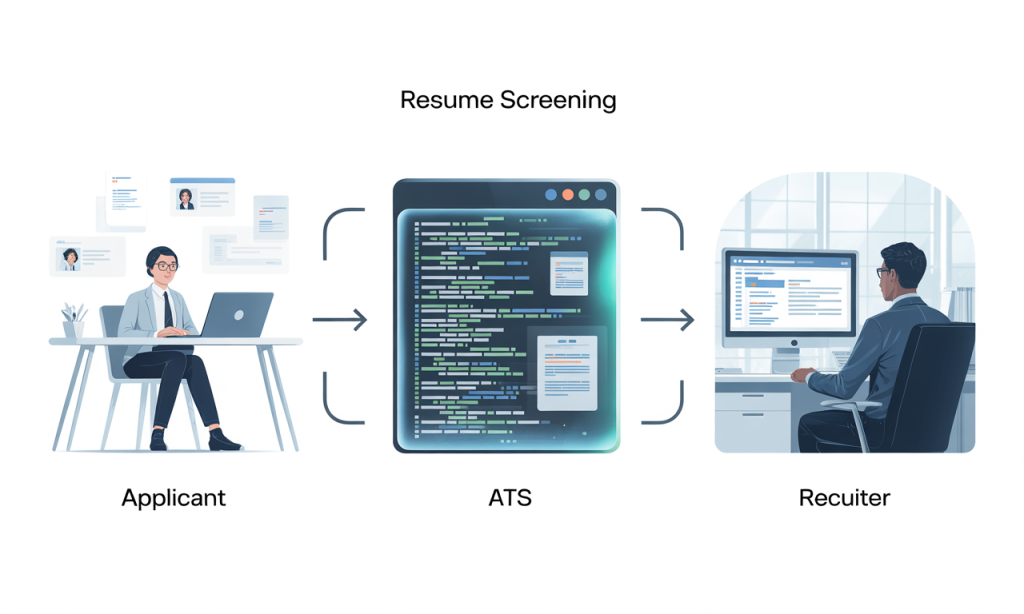
Applicant Tracking Systems (ATS) are widely used, but their impact on resume visibility is often misunderstood.
-
- A CareerMinds blog (2025) claimed that “75% of resumes may never be seen by a human” due to formatting issues or missing keywords (CareerMinds).
-
- However, HR professionals and a University of Washington–backed study note that this statistic is a myth, popularized in marketing materials without real research (HiringThing).
The reality: most resumes are at least reviewed, but poorly optimized ones still get lost.
That’s why direct, personalized outreach to recruiters and hiring managers is becoming the true differentiator. Done right, it helps you:
-
- Break through the “resume black hole”
-
- Stand out in competitive applicant pools
-
- Open real conversations that lead to interviews
This guide walks you step by step through using AI for recruiter outreach, from finding the right people to writing the perfect message to following up with confidence. You’ll also see how HirePilot automates the workflow so you save time and focus on real connections.
Why personalization matters more than ever
Recruiters aren’t ignoring you on purpose. They’re overwhelmed. For every role, they may receive hundreds of applications. Generic outreach doesn’t work anymore.
-
- 83% of companies plan to use AI to review resumes by the end of 2025 (Interview Guys).
-
- Already, 79% of recruiters use AI tools for candidate screening, and automation reduces time-to-hire by 35% (Recruiters LineUp).

Meanwhile, personalization is rising across industries:
-
- 89% of marketing executives believe personalization is critical to business success in the next three years.
-
- Yet only 60% of customers feel they receive personalized experiences, showing a big perception gap (Contentful).
The truth? Most applicants never even send a single outreach message. That means the bar to stand out is much lower than you think.
Related reading: If your resume itself isn’t optimized, even outreach won’t help. See our guide: ATS Keywords in 2025: Resume Examples That Get Past the Bots.
Once the limitations of ATS-only applications are clear, the question becomes how to apply outreach systematically rather than randomly.
A 4-Step Guide to AI Recruiter Outreach
Step 1: Build a Target List for AI Recruiter Outreach
The success of your AI recruiter outreach hinges on contacting the right people. Sending a generic message to a random recruiter is ineffective. Instead, build a targeted list that includes three key types of contacts for each role you pursue. This multi-touch approach is essential for improving your visibility with hiring managers quickly.
- The Recruiter: They are the gatekeepers managing the application process. Check the job posting for their name or search on LinkedIn for “Talent Acquisition” or “Recruiter” at the company. Contacting them ensures your application gets noticed in the system.
- The Hiring Manager: This is the person you would report to and the ultimate decision-maker. They are looking for a solution to their team’s needs. Find them by searching for the head of the relevant department, such as “Director of Marketing” or “Head of Engineering.”
- A Peer or Alumni: This contact provides social proof and an insider’s perspective. Find someone in a similar role or an alumnus from your school working at the company. A referral from a peer can significantly boost your application’s standing, as many companies prioritize referred candidates.
Contacting 2-3 people across these categories for each role multiplies your chances of getting a response.
Step 2: Craft AI-Powered Outreach Messages That Get Replies
Once you have your target list, the next step is to craft messages that command attention. The key is to personalize your cold messages effectively, even when using AI. A simple formula works best: Hook → Context → Value → Call-to-Action.
- Hook: Start with a personalized reference. Mention a recent company project, a shared connection, or an article they wrote. This shows you’ve done your research.
- Context: Clearly state why you are reaching out. Mention the specific role you applied for.
- Value: Briefly explain what you bring to the table. Focus on a key achievement or skill that aligns directly with the job’s requirements.
- Call-to-Action: End with a clear, low-effort next step. Instead of asking for a 30-minute call, ask if they are open to a brief chat or if you can send a one-page summary of your work.
AI can generate drafts for each contact type, but your job is to add the specific, human details that make the message feel authentic and compelling. Remember that recruiters often don’t respond to messages that are generic or fail to demonstrate immediate relevance.
Step 3: Implement an AI-Powered Timing and Follow-Up Strategy
Timing is critical. The best message sent at the wrong time can get lost in a crowded inbox. A strategic follow-up plan ensures your outreach gets seen without being pushy.
- Initial Outreach: Send your first message 1-3 days after submitting your application. This gives the system time to process your application while the role is still top of mind for the hiring team.
- Follow-Up: If you don’t receive a response, send a gentle follow-up 7-10 days after your initial message. A brief note checking in on your application is sufficient.
A well-timed follow-up can increase your response rate significantly. As a rule, two polite attempts are enough. After that, it’s best to move on and focus your energy on another contact or opportunity.
Step 4: Automate Your AI Recruiter Outreach Workflow
Managing this process manually for multiple job applications is time-consuming and prone to errors. This is where recruiter outreach automation becomes a powerful ally. Using AI-powered tools like HirePilot helps streamline the entire workflow, from research to follow-up.
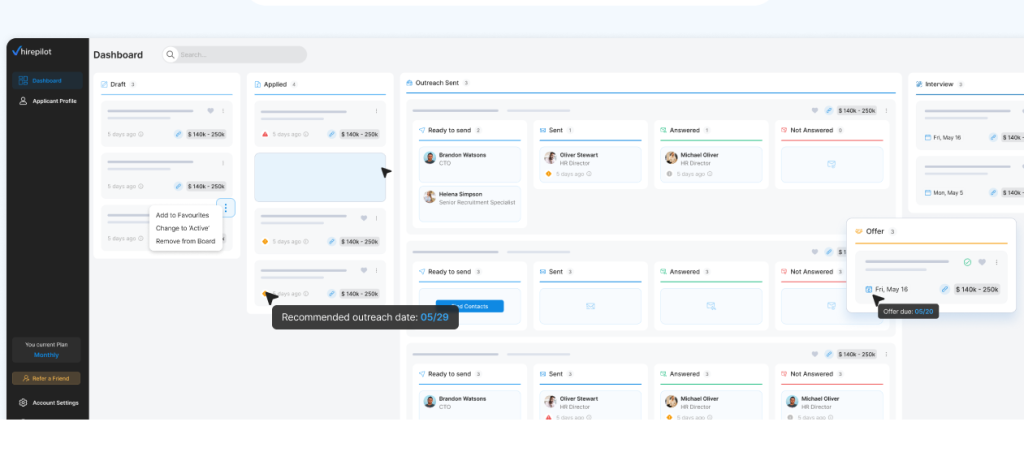
An effective workflow integrates several key functions:
- Contact Identification: Automatically finds recruiters, hiring managers, and peers for your target companies.
- AI Message Generation: Creates tailored outreach drafts for each contact type, which you can then customize.
- Automated Follow-Ups: Schedules and sends polite reminders to contacts who haven’t responded.
- Pipeline Tracking: Organizes your applications in a single dashboard, allowing you to monitor your progress from “Applied” to “Interview” to “Offer.”
By automating these steps, you save valuable time, maintain consistency across all your applications, and can focus your efforts on preparing for the interviews that your strategic outreach will secure.
FAQ: Personalized AI Recruiter Outreach
- How does AI specifically help with personalizing outreach messages?
AI tools analyze the recipient’s LinkedIn profile, recent posts, or company news to extract relevant talking points. This data is then synthesized to create a customized opening line or “hook” that connects the candidate’s background to the recipient’s current professional focus. - What is the ideal length for a recruiter outreach message?
The most effective messages are concise, typically falling between 75 and 125 words. This length is sufficient to state the reason for contact and the value proposition, but short enough to be read on a mobile screen without scrolling. - Is it better to contact the recruiter or the hiring manager?
It is generally more effective to contact the hiring manager because they have the direct need and budget authority. However, contacting the internal recruiter is also valid, particularly to ensure your formal application is noticed within the tracking system. - How soon after applying should I send an outreach message?
Ideally, the outreach message should be sent within 24 to 48 hours of submitting the formal application. This ensures that your name is fresh in the system and demonstrates a proactive attitude toward the role. - Can using AI for outreach get my account banned on platforms like LinkedIn?
Yes, if used aggressively or without regarding platform limits; excessive automation or sending too many identical messages can trigger anti-spam filters. It is crucial to use tools that respect daily limits and vary the content of messages to maintain account safety.
Moving Toward a Comprehensive Strategy
Understanding the mechanics of AI recruiter outreach, from the algorithmic filters to the human psychology of responsiveness, provides the necessary foundation for execution. However, knowing why the system works is different from knowing exactly how to execute a successful campaign across multiple channels. To translate this understanding into a cohesive plan that converts applications into interviews, it is necessary to integrate these insights into a broader, step-by-step workflow.