

The notification pops up on your screen: “Invitation to Interview.”
For a moment, there is a rush of adrenaline. It’s validation. It’s proof that your resume worked, your application stood out, and someone sees potential in your profile. But almost immediately after the excitement fades, a different feeling often settles in.
Anxiety.
Suddenly, the stakes feel higher. The questions start swirling: What if I freeze up? What if they ask something I don’t know? What if I’m not what they’re looking for?
Getting an interview is a massive win in itself. It means you have already cleared the biggest hurdle, getting noticed. But what you do next can make or break your chances. Effective job interview preparation isn’t just about rehearsing canned answers or memorizing the company’s mission statement; it is about building unshakeable confidence, managing your physiological response to nerves, and staying true to yourself under pressure.
When you walk into that room or log onto that Zoom call, you want to feel grounded, not frantic. You want to shift from hoping they like you to evaluating if this is the right environment for you to thrive.
Here are 9 extensive, practical tips to help you show up with confidence, master your interview prep, and leave a lasting impression that turns a conversation into an offer.
1. Prepare with intention, not just repetition
Many candidates make the mistake of over-rehearsing. They memorize scripts for every possible question until they sound robotic. While you need to know your stuff, true preparation is about intention, not just repetition.
Start by digging deeper than the “About Us” page. Look at the company’s recent news, their product roadmap, and even their challenges. When you understand the problems they are trying to solve, you can position yourself as the solution. This shifts your mindset from “I need a job” to “I can help you grow.”
Think through your story. Why this role? Why now? Connect your personal values to the company’s mission. When you speak from a place of alignment rather than desperation, your confidence naturally rises.
If you want to further understand what differentiates successful candidates, reading about the importance of emotional intelligence in the workplace can add another layer to your preparation and help you stand out during interviews.
Analyze the job description like a detective
Don’t just read the job description; dissect it. Highlight the verbs. Are they looking for someone to lead, create, manage, or support? These words are clues to the personality and soft skills they prioritize.
If you are feeling stuck in your job search or feel like you are just guessing what they want, this analysis is crucial. It helps you tailor your prep to the specific language the company uses, making you sound like an insider before you are even hired.
Pro Tip: Instead of just reviewing generic questions, try this: record yourself answering a tough question, like “What’s your biggest weakness?”, and then watch how you come across. Are you defensive? Vague? Or do you own your growth areas with confidence? Watching yourself on video can be cringey at first, but it is the fastest way to spot nervous ticks or lack of clarity.
2. Use the STAR method to talk about your experience
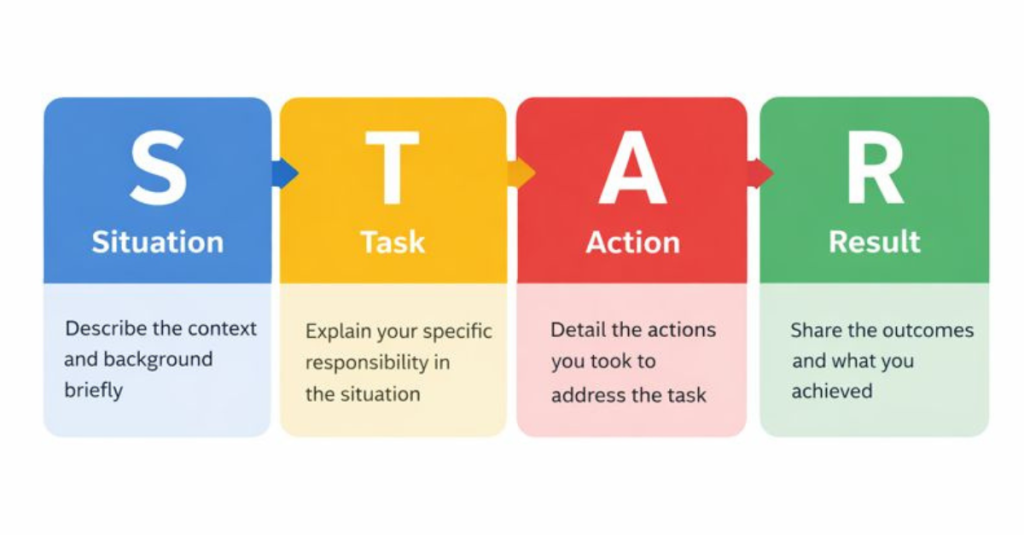
One of the biggest confidence killers in a job interview is rambling. You start telling a story, get lost in the details, and suddenly forget the original question. The solution is structure.
The STAR method is the industry standard for answering behavioral questions because it provides a linear narrative that is easy for interviewers to follow.
- S – Situation: Set the context briefly. (Where were you? What was the context?)
- T – Task: What was your specific responsibility? (Not just the team’s goal, but yours.)
- A – Action: What did you actually do? (This is the most important part, focus on your contribution.)
- R – Result: What changed? (Use numbers, percentages, or qualitative feedback.)
If you’re practicing your interview technique and want actionable feedback, the STAR interviewing approach recommended by Indeed can help you refine your answers to best showcase your achievements.
Deepening your STAR stories
A common mistake is spending too much time on the Situation and not enough on the Action and Result. The interviewer cares less about the background drama and more about your problem-solving skills.
When preparing your stories, try to map them to the core competencies of the role. If the job requires cross-functional collaboration, have a STAR story ready about a time you navigated a conflict between teams.
Example:
Q: “Tell me about a time you solved a complex problem at work.”
S: Our biggest client was threatening to cancel their contract due to missed deadlines on a software implementation. The team was demoralized and communication had broken down.
T: As the project lead, I needed to identify the bottleneck, restore the client’s trust, and get the project back on track without burning out the team.
A: I organized a “war room” meeting to map out the entire workflow. I identified that the approval process was delaying every stage by three days. I implemented a simplified 24-hour approval protocol and set up daily 15-minute stand-ups with the client to ensure transparency.
A: We not only met the original deadline but the client was so impressed with the turnaround transparency that they expanded their contract the following month by 20%.
Another example:
Q: “Tell me about a time you took initiative.”
S: Our onboarding process was confusing for new hires, leading to low productivity in the first month.
T: I noticed new team members were constantly asking the same questions about our internal tools.
A: I created a comprehensive digital welcome guide and a video library of tutorials during my downtime.
R: Within a month, new hire support tickets dropped by 60%, and the guide was adopted as the company-wide standard.
Developing a library of these stories is a cornerstone of methods to stay confident during a job interview. When you know you have a story for every scenario, you fear the questions less.
3. Don’t aim to be “Perfect.” Be yourself
There is a pervasive myth that you need to be a flawless candidate to get hired. This leads to interviewers hearing answers that sound rehearsed and inauthentic.
Interviewers are humans looking to hire humans, not robots. They can tell when you are performing. Perfectionism creates a barrier; authenticity builds a bridge.
If you don’t know the answer to a technical question, don’t fake it. It is far more impressive to say, “I haven’t encountered that specific scenario yet, but here is how I would go about finding the solution.” This shows resourcefulness and honesty, traits that are often valued higher than rote knowledge.
To reinforce the value of authenticity in interviews and job searching, you can explore key elements employers look for beyond your resume for insights that may boost your own approach.
The “Culture Add” vs. “Culture Fit”
For a long time, advice focused on “culture fit”, trying to mold yourself into what you think the company is. Modern hiring focuses on “culture add”, what unique perspective do you bring?
Embrace your unique background. Maybe you have a non-traditional path into tech, or you took a career break to travel. Don’t hide these. Frame them as assets that give you a broader worldview.
Example: “I haven’t used that specific project management tool directly, but I’ve worked with similar agile platforms like Jira and Asana, and I’m confident I can pick it up quickly.”
4. Reframe nerves as excitement

Physiologically, anxiety and excitement are almost identical. Both involve a racing heart, sweaty palms, and heightened alertness. The only difference is the narrative your brain attaches to those sensations.
When you tell yourself “I’m anxious,” your brain prepares for a threat. It shuts down creative thinking and focuses on survival (fight or flight). When you tell yourself “I’m excited,” your brain prepares for an opportunity. This is a concept known as “anxiety reappraisal.”
The Athlete’s Trick
Top athletes use this constantly. You rarely hear an Olympian say they are terrified before a race; they say they are pumped up.
Try this before your next interview:
When you feel that pit in your stomach, say out loud: “I’m excited to share my ideas. I’m excited to meet this team.” It sounds simple, but Harvard Business School research suggests that saying “I am excited” improves performance on anxiety-inducing tasks significantly more than trying to calm down.
Also, focus on your breathing. Deep, diaphragmatic breathing stimulates the vagus nerve, which signals your body to relax. Take a “box breath” before you log on: Inhale for 4 counts, hold for 4, exhale for 4, hold for 4.
5. Pause before you answer
In normal conversation, we often interrupt or answer immediately to show we are listening. In a job interview, this can work against you. Rushing your answer often leads to shallow responses or rambling as you try to think and talk simultaneously.
It is okay to pause. In fact, it is a powerful move.
Taking 3–5 seconds to think before you speak shows confidence. It signals that you are thoughtful and that you respect the question enough to consider your answer carefully. It also gives you a moment to structure your STAR response in your head.
Practice this: Ask a friend to throw you random questions and deliberately pause before each answer. Count to three in your head.
Bonus phrase: If you need more time, use a bridge phrase like:
- “That’s a really interesting question, let me think about the best example for a moment.”
- “I want to make sure I give you a precise answer, let me reflect on a specific project.”
Silence is only awkward if you look panicked. If you look contemplative, silence is powerful.
6. Prepare questions that show you care
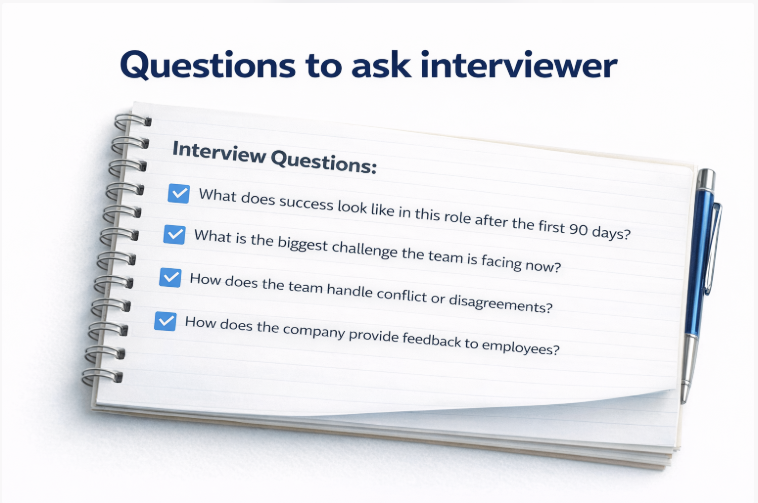
Toward the end of the interview, the inevitable question comes: “Do you have any questions for us?”
Saying “no” is a major red flag. It suggests you haven’t done your homework or aren’t truly interested in the role. Conversely, asking insightful questions can salvage a mediocre interview. It shows strategic thinking and engagement.
Don’t ask questions that can be answered by a quick Google search (e.g., “What do you sell?”). Ask questions that help you uncover the reality of the role and the company culture.
Strategic questions to ask:
- “What does success look like in this role after the first 90 days?” (Shows you are goal-oriented).
- “What is the biggest challenge the team is currently facing, and how would this role help solve it?” (Shows you want to be a problem solver).
- “How does the team handle conflict or creative disagreements?” (Reveals culture).
- “I read about your recent expansion into [Market X]; how does this team contribute to that growth?” (Shows you researched).
Having a list of top interview questions, both to answer and to ask, is a key part of your prep kit. It changes the dynamic from an interrogation to a two-way business conversation.
7. Visualize a positive outcome
Visualization isn’t magic; it’s neuroscience. When you vividly imagine a scenario, your brain activates the same neural pathways as it does when you actually perform the action. This is why musicians, surgeons, and athletes visualize their performance beforehand.
If you spend the days before your interview imagining yourself failing, stumbling over words, or looking foolish, you are essentially rehearsing failure. You are priming your brain to be anxious.
The Visualization Exercise:
Spend 2 minutes the morning of the interview closing your eyes.
- Picture yourself walking into the building (or logging into the video call).
- Imagine greeting the interviewer with a genuine smile.
- Feel your shoulders relaxing and your breath steadying.
- Visualize yourself answering a tough question with clarity and calm.
- Imagine the feeling of relief and pride as you say goodbye.
According to Psychology Today, this mental rehearsal prepares your brain to handle the stress of the actual event with more familiarity and control.
8. Follow up with gratitude and confidence
The interview doesn’t end when you hang up. The follow-up is your final opportunity to leave a positive impression.
Always send a thank-you note. But do not just copy-paste a generic template found online. Recruiters receive hundreds of “Thank you for your time” emails. They are forgettable.
Make it specific. Mention a detail from the conversation, a shared interest, a specific project they mentioned, or a joke you laughed at. This proves you were listening and reinforces the connection.
Example:
“Hi [Name], Thank you again for the great conversation about the new product launch. I particularly loved hearing about how your team is tackling the user retention challenge. It reminded me of a similar project I led, and I’d be thrilled to bring that experience to your next big milestone.”
When to send it:
Ideally, send your follow-up email within 24 hours. If it’s a Friday interview, sending it Monday morning is acceptable, but sooner is generally better to keep momentum.
If you are unsure of the etiquette, checking a guide on how to follow up can ensure you strike the right tone between eager and professional.
9. Practice with someone else
You can memorize answers in your head all day, but speaking them out loud is different. Words can get jumbled, or you might realize an explanation that made sense in your mind is confusing when spoken.
Mock interviews are the gold standard of interview prep. They force you to articulate your thoughts in real-time.
Try this:
Ask a friend, mentor, or career coach to do a 20-minute mock interview. Give them a list of questions, but tell them to go off-script if they want.
The most important part: Record it.
Use your phone or a Zoom recording. Watching yourself is uncomfortable, but it reveals everything:
- Do you say “um” or “like” every other word?
- Do you avoid eye contact?
- Do you slouch?
- Is your tone monotonous?
If you don’t have a partner, AI tools can help. There are plenty of AI job search tools emerging that can analyze your speech patterns and give you feedback on your pacing and keyword usage.
Even better: Practice with someone who works in your target industry. They will give you insider insight and ask the specific technical questions that a general friend wouldn’t know.
If you want to dig deeper into strategies for effective communication, this resource on public speaking tips from Toastmasters International can help you take your interview skills to a new level.
Bonus: Navigating the Virtual Interview
In today’s market, your first few rounds,if not the entire process, will likely be virtual. This adds a layer of “tech check” to your prep.
- Eye Contact: In a video call, eye contact means looking at the camera lens, not the face on the screen. It feels unnatural, but it makes the interviewer feel you are looking at them.
- Lighting: Ensure your face is well-lit. Do not sit with a window behind you (you will look like a silhouette).
- Background: Keep it clean and professional. A messy room can subconsciously signal a disorganized mind.
- Cheatsheets: One advantage of virtual interviews is that you can have notes. Stick Post-it notes around your monitor with keywords like “STAR method,” “Smile,” or “Slow down.” Just don’t read them verbatim.
Understanding these nuances is part of effective job search strategies. Treating the technical setup with the same seriousness as your resume shows professionalism.
Final thoughts
Confidence isn’t about having all the answers or never feeling nervous. It is about showing up prepared, grounded, and authentic. It’s about shifting your focus from “I hope they pick me” to “Here is the value I can bring.”
The job search process is a marathon, not a sprint. You might face rejection. You might have awkward interviews. That is part of the journey. But with the right mindset, the right preparation steps, and the willingness to learn from each experience, you will turn those nerves into presence and those interviews into offers.
Trust your preparation. You have done the work. Now go show them who you are.
FAQ: Interview Prep & Building Job Interview Confidence
1. What is the STAR method in interviews and why is it so important?
The STAR method is a structured technique for answering behavioral interview questions by outlining the Situation, Task, Action, and Result. It is critical because it keeps your answers concise and focused on your specific contributions, preventing you from rambling. By ending with a concrete result, you provide proof of your effectiveness, which is far more persuasive than vague generalizations about your skills.
2. How do I calm interview anxiety right before the call starts?
First, try to reframe your physiological nervousness as excitement, telling yourself “I am excited” to shift your mindset from threat to opportunity. Practice deep breathing exercises, such as box breathing, to lower your heart rate and signal safety to your nervous system. Additionally, visualizing a successful interaction, smiling, answering clearly, connecting with the interviewer, can help reduce the fear of the unknown.
3. Should I follow up after every interview, even if I think it went poorly?
Yes, absolutely. A thoughtful thank-you email sent within 24 hours demonstrates professionalism and resilience, traits employers value highly. You can even use the follow-up to clarify a point you feel you didn’t explain well during the interview (“I realized I didn’t fully expand on…”). It helps you stand out from the majority of candidates who never send a note.
4. What if I don’t have much experience or I am changing careers?
Focus heavily on your transferable skills, leadership, project management, communication, or problem-solving, that apply across industries. Use the STAR method to frame school projects, volunteer work, or personal initiatives as professional achievements. Employers often hire for potential, attitude, and teachability over a perfect checklist of past job titles.
5. What if I’ve been rejected 10+ times and my confidence is shattered?
Rejection is a painful but normal part of the process; try not to take it as a judgment on your worth as a person. Take a step back to review your strategy, is your resume passing ATS? Are you practicing enough for interviews? Sometimes, taking a break to rebuild confidence after job rejections is necessary before diving back in. Remember, you only need one “yes.”
6. How should I dress for a virtual interview?
Treat a virtual interview exactly like an in-person one; dress professionally from head to toe (don’t risk pajama bottoms!). dressing the part helps put you in a professional mindset psychologically. Aim for business casual or whatever is appropriate for your industry, but avoid distracting patterns that might flare on camera.
Ready to streamline your entire job search?
Applying for jobs, tracking them, and preparing for interviews can feel like a full-time job in itself. HirePilot helps you automate the tedious parts, like auto-filling applications and tracking your progress, so you can focus your energy on what matters: nailing the interview.
Take control of your career journey today.