



You find a business analyst role that fits. The company looks right, the scope matches your background, and the salary range works. Then you open the application and hit the cover letter field.
Most candidates type something that starts with "I am a results-driven business analyst with five years of experience." The hiring manager has read that sentence three hundred times. It does nothing.
A business analyst role requires you to translate complex problems into clear solutions. Your cover letter is the first test of whether you can actually do that. This guide gives you the structure, a ready-to-use template, and two realistic examples you can adapt today.
Skills needed for a business analyst
Hiring managers are not scanning for all of these. They are looking for two or three that match their exact problem. These are the ones that appear most consistently across current BA postings.
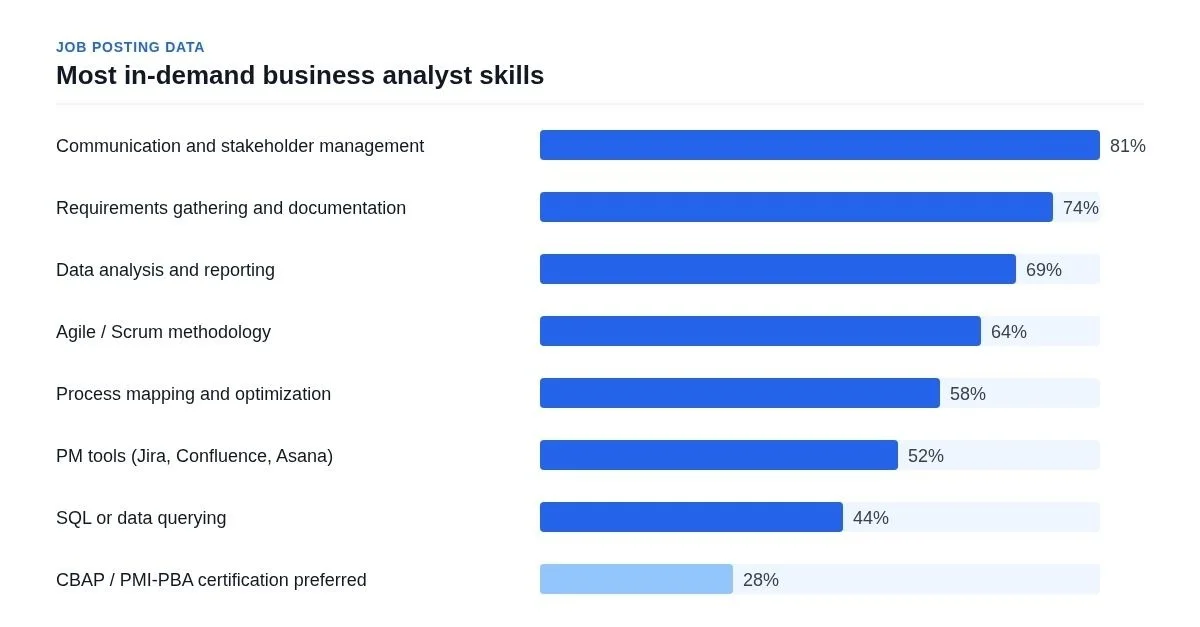
Technical and analytical skills:
- Requirements gathering and documentation (user stories, functional specs, acceptance criteria)
- Data analysis and translating findings into actionable recommendations
- Proficiency with tools like Jira, Confluence, Asana, or similar project tracking software
- SQL or basic data querying (increasingly expected even in non-technical BA roles)
- Agile and Scrum methodology
- Process mapping and workflow optimization
- Familiarity with ERP or enterprise systems (SAP, Salesforce, Workday depending on industry)
Soft skills and communication:
- Stakeholder management across technical and non-technical teams
- Facilitating workshops and requirements sessions
- Translating business needs into language engineers can act on
- Managing competing priorities and ambiguous requirements
- Executive-level written and verbal communication
Pick two or three from this list that match the specific posting. Then build your letter around those.
Certifications worth mentioning
If you hold a CBAP (Certified Business Analysis Professional) or CCBA from the International Institute of Business Analysis, mention it once in the body of your letter. Both are recognized across industries and signal that you take the discipline seriously.
Other credentials worth a brief mention if relevant:
- PMI-PBA (Professional in Business Analysis)
- PMP (especially for BA/PM hybrid roles)
- Agile certifications (CSM, PMI-ACP) for Agile-focused environments
- Six Sigma for process improvement-heavy roles
One sentence is enough. The resume expands on it. The cover letter just signals you have it.
What to include in a business analyst cover letter
A strong letter has five parts. Keep each section tight.
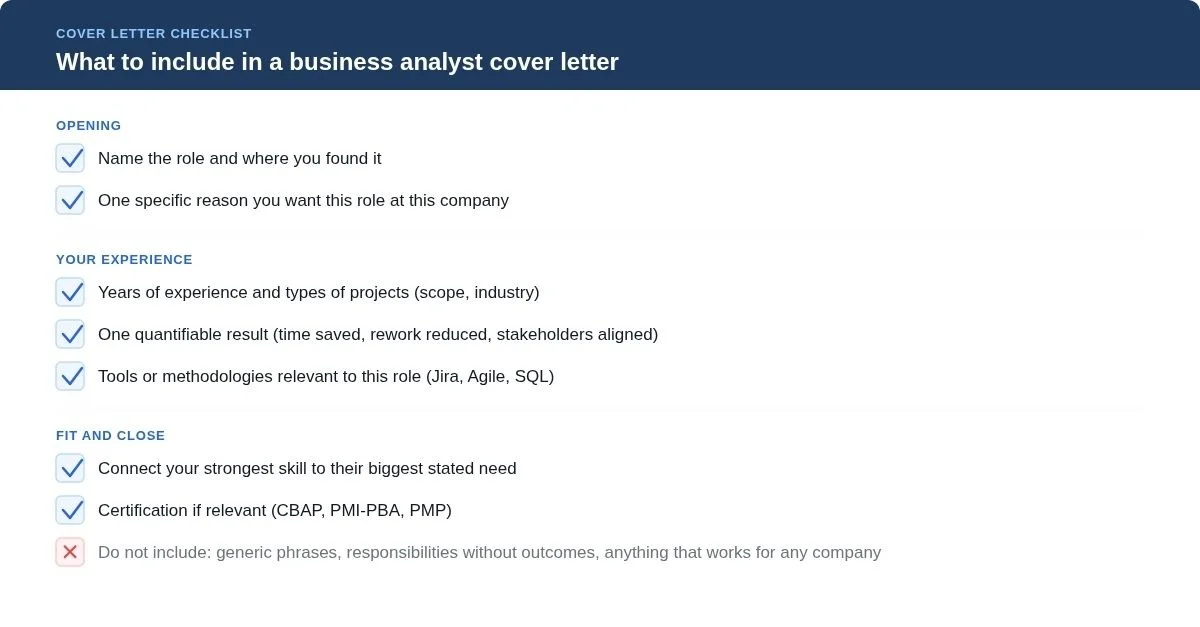
Opening. State the role and one specific reason you want this position at this company. Not a generic reason. Something tied to their industry, tech stack, or a challenge visible in the job description.
Why this company. One or two sentences about something concrete: the type of systems they work with, the scale of the problems they are solving, or a transformation initiative you read about. This shows you did the work.
Your experience. Two to three sentences covering your years as a BA, the types of projects you have led, and a quantifiable result. Processes improved, time saved, stakeholder alignment achieved.
Why you. Connect your strongest skill directly to their biggest stated need. If the posting emphasizes stakeholder communication and requirements documentation, lead with that.
Closing. Express interest in next steps, confirm availability, thank them for their time. One short paragraph.
Most cover letters fail for one reason. They try to sound impressive instead of being specific. Specificity is what gets read. Keep that in mind as you use the template below.
Business analyst cover letter template
Use this as your starting point. Replace every placeholder with specific details. A quick test before you send: if your letter still works when you replace the company name, it is too generic.
[Your Name] [City, State] [Email] | [LinkedIn URL]
Dear [Hiring Manager Name],
I am applying for the [Job Title] role at [Company Name]. With [X] years of experience as a business analyst in [industry or environment], I have developed a strong track record in [one key area, e.g., "translating complex stakeholder requirements into clear functional specifications that engineering teams can act on"].
[Company Name]'s focus on [specific detail from job posting, e.g., "AI-enabled HR transformation" or "cross-functional operations in a fast-moving technology environment"] is directly aligned with the work I have been doing at [Current/Previous Company]. I was drawn to this role in particular because of [specific detail that makes this opportunity distinct from others].
In my most recent role as [Your Title] at [Previous Company], I [specific achievement with context]. I led [specific project type], working closely with [stakeholders], and [measurable outcome, e.g., "reduced the requirements review cycle by three weeks by introducing a structured intake process"].
I hold [CBAP/PMI-PBA/relevant certification] and have hands-on experience with [Jira/Confluence/relevant tool]. I am confident in my ability to [connect directly to their stated need].
I would welcome the opportunity to discuss how my experience aligns with this role. I am available at your convenience.
Thank you for your time and consideration.
[Your Name]
Business analyst cover letter examples
Example 1: Entry-level BA, technology company
Jordan Mills Austin, TX jordan.mills@email.com | linkedin.com/in/jordanmills
Dear Hiring Team,
I am applying for the Business Operations Analyst role at Meridian Technologies. With a background in business analysis and project coordination developed through both coursework and a year of hands-on work in cross-functional operations, I bring strong written communication skills and a genuine interest in how large technology organizations run at scale.
Your team's work at the intersection of operations and strategy, supporting both internal stakeholders and executive leadership, is the kind of environment where I do my best work. I was drawn specifically to this role because of the emphasis on translating operational data into clear recommendations, which is where I have been building focused experience.
In my previous role supporting a regional operations team, I drafted executive-level summaries and tracked project milestones across three concurrent initiatives. I identified a reporting gap that was adding two days to each status cycle and proposed a consolidated dashboard that reduced that lag to same-day. I have advanced proficiency in Microsoft PowerPoint and Excel, and I am comfortable working directly with senior stakeholders to refine complex content into clear, audience-appropriate formats.
I hold a Bachelor's degree in Business Administration and have completed coursework in Agile project management. I am a proactive communicator who takes ownership of deliverables without needing close direction.
I would welcome the opportunity to learn more about the team and this role. Thank you for your consideration.
Jordan Mills
Example 2: Mid-senior BA, HR and enterprise systems transformation
Priya Nair Denver, CO priya.nair@email.com | linkedin.com/in/priyanair
Dear Hiring Manager,
I am applying for the Business Analyst, HR Transformation role at Stratus Group. With eight years of experience as a business analyst working at the intersection of HR programs and enterprise technology, I bring both the functional understanding of talent processes and the technical fluency to translate business intent into requirements that IT and vendors can actually deliver on.
Your focus on moving HR operations from digitized legacy processes toward AI-enabled workflows reflects exactly the kind of transformation work I have been doing for the past three years. I understand that this role lives on the business side, shaping requirements rather than configuring systems, and that distinction matters. The value is in what gets built, not who touches the buttons.
In my current role, I led the requirements design for a SAP SuccessFactors implementation covering performance and workforce planning modules for 6,000 employees across four regions. I facilitated 40-plus stakeholder sessions, translated competing priorities into a structured backlog, and reduced post-launch change requests by 30% by front-loading ambiguity resolution in the design phase. I work closely with People Analytics and Digital Enablement teams and have experience shaping AI readiness requirements within enterprise HR platforms.
I hold a CBAP certification and have hands-on experience with Jira, Confluence, and SAFe Agile practices. I bring a "yes, if" mindset to constraints rather than accepting no as a default.
I would be glad to speak further about this role and how my background maps to the transformation priorities at Stratus Group. Thank you for your time.
Priya Nair
Common mistakes to avoid
Opening with your job title and years of experience. "I am an experienced business analyst with six years in the field" is a resume summary, not a hook. Start with something specific to the role or company.
Describing responsibilities instead of outcomes. "I was responsible for gathering requirements" tells the reader nothing. "I led requirements sessions with 12 stakeholders across three departments and reduced development rework by 25%" tells them something real.
Using the same letter for every application. BA roles vary enormously between industries, company sizes, and tech stacks. A letter written for a healthcare LIS role will not land at a tech company doing AI transformation, and vice versa.
Skipping the company research. One sentence that shows you read the job description carefully does more work than three paragraphs of generic claims.
Running long. One page. Four to five short paragraphs. If you are going beyond that, you are including things that belong on the resume.
One more step most candidates skip
Most candidates submit their application and wait. That waiting is where most job searches stall.
The candidates who get more interviews treat the application as the first step, not the last. They reach out directly to the hiring manager the same day they apply. A short, personalized message referencing the role and making a specific connection. That combination is what separates the candidates who hear back from the ones who do not.
If you want to understand how your letter gets filtered before it reaches a human, knowing how ATS systems work and how to bypass their filters is worth the 10 minutes it takes to read. And once you apply, a well-timed job application follow-up can be the difference between silence and a reply.
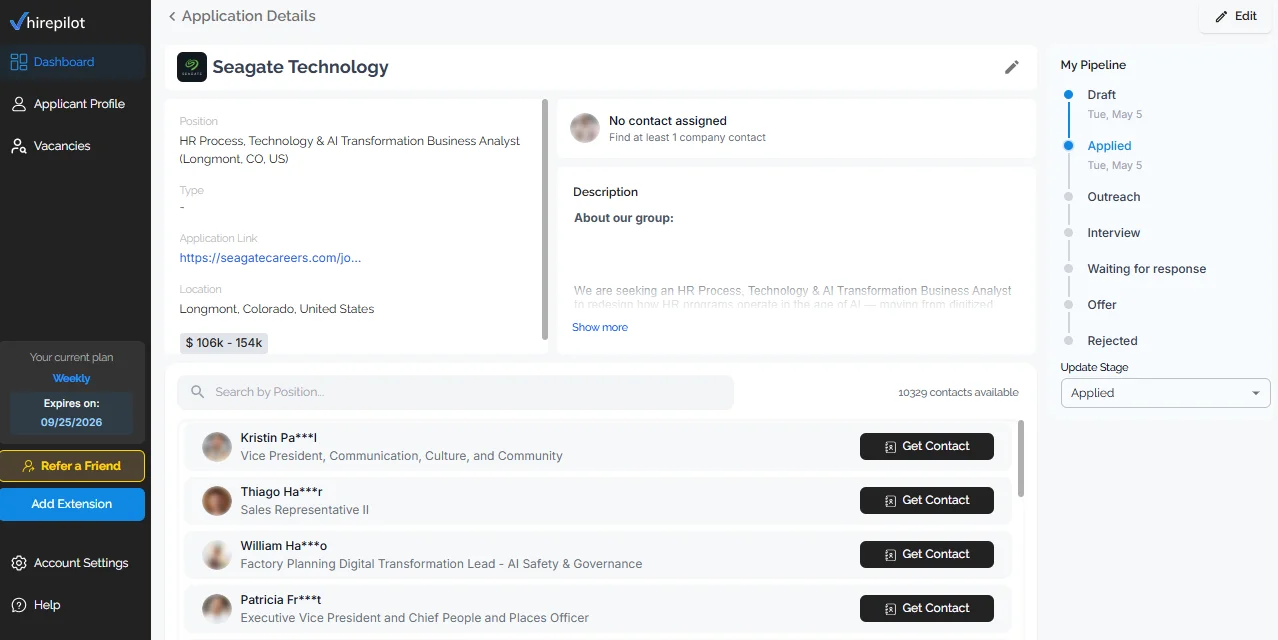
HirePilot handles both the application and the outreach in one workflow. You autofill the form, and the tool finds the hiring manager so you can send a personalized message the same day, without spending an hour on LinkedIn research.
FAQ: Business analyst cover letter
What is a good business analyst cover letter?
A strong one is specific, short, and focused on what you have delivered. It connects your experience directly to the stated needs of the role, includes at least one measurable result, and avoids generic phrases without context. One page, four to five paragraphs.
How long should a business analyst cover letter be?
One page. Aim for 300 to 400 words. BA roles require clear, efficient communication. A letter that runs long works against you.
Should I mention CBAP or PMI-PBA in a cover letter?
Yes, if you have either. Mention it once, briefly, in the body of the letter. CBAP in particular signals serious commitment to the discipline and carries weight with hiring managers who know what it takes to earn it.
What is the best way to open a cover letter for a business analyst role?
Start with the role name and one specific reason you want this position at this company. Avoid "I am writing to express my interest." Lead with something concrete about the problem you solve or a specific detail about the company that makes your application distinct.
Do business analysts still need cover letters?
For most mid-level and senior roles, yes. Even when listed as optional, submitting one signals the initiative and communication skills that every BA role requires. For entry-level roles at large tech companies, cover letters are often used to filter candidates before the resume review begins.
Find your next job faster - without the chaos
Spend minutes, not hours, on applications. Stay organized, follow up confidently, and get noticed sooner.
Share this article

Viktor Shumylo
Viktor Shumylo is the co-founder of HirePilot, an AI-powered job search platform. He has 10+ years of experience building SaaS products and tools that help job seekers optimize resumes, streamline applications, and land interviews faster.
More articles by Viktor Shumylo