


You have built models that drove revenue decisions. You have translated complex outputs into strategies that non-technical stakeholders could act on. You have done the hard work of turning messy data into something that actually moves a business forward. Then you sit down to write a cover letter and it comes out sounding like a list of tools and degree credentials.
Most data scientist cover letters read like a technical resume summary. "Proficient in Python, SQL, and machine learning. Experience with Scikit-learn, TensorFlow, and Spark." Every candidate says this. The hiring manager, who is often a data science lead or a VP of Analytics, has read it hundreds of times.
What works is showing what you did with those tools. The model that increased conversion by a measurable amount. The forecasting framework that replaced a manual planning process. The recommendation engine that surfaced revenue opportunities the GTM team had not been seeing. That specificity is what separates a letter that gets a response from one that gets archived.
This guide gives you the structure, a ready-to-use template, and two realistic examples you can adapt today.
Skills needed for a data scientist
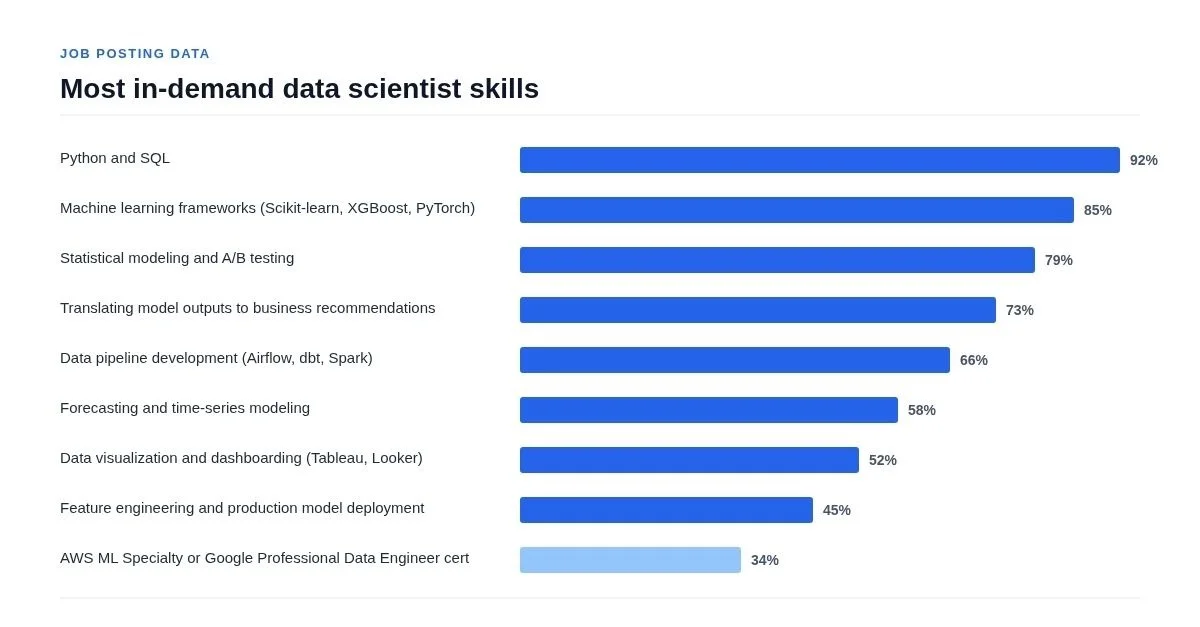
Hiring managers are not scanning for everything on this list. They are looking for two or three skills that match the specific problem they are trying to solve. Data science roles vary significantly by function, growth, finance, forecasting, product, operations and the skills that matter most shift accordingly. These are the ones that appear most consistently across current postings.
Technical and modeling skills:
- Python and SQL at an expert level
- Machine learning frameworks (Scikit-learn, XGBoost, PyTorch, TensorFlow)
- Statistical modeling, A/B testing, and experimentation design
- Data pipeline development (Airflow, dbt, Spark)
- Forecasting and time-series modeling
- Feature engineering and model deployment in production environments
- Data visualization and dashboarding (Tableau, Looker, or similar)
- Generative AI and LLM integration for applied use cases
Business and communication skills:
- Translating model outputs into business recommendations non-technical stakeholders can act on
- Partnering with GTM, Finance, Product, and Operations teams
- Defining metrics, KPIs, and success criteria for data products
- Building frameworks to measure incremental impact beyond correlation
- Documentation, executive summaries, and stakeholder communication
The specific skills that matter most depend on the function. A data scientist on a growth team needs strong GTM metrics knowledge and experimentation experience. A data scientist in forecasting needs time-series expertise and planning cycle experience. A data scientist embedded in finance needs SQL depth and financial data architecture fluency. Read the posting carefully and lead with the two skills they have prioritized most.
Certifications and education worth mentioning
Data science hiring is credential-aware but not credential-dependent. If you hold a graduate degree in a quantitative field, statistics, mathematics, computer science, operations research, or economics, mention it once. For senior roles especially, a Master's or PhD signals the depth of statistical foundation the work requires.
If you hold relevant certifications, a brief mention is appropriate:
- AWS Certified Machine Learning Specialty for cloud-native ML roles
- Google Professional Data Engineer for pipeline and infrastructure-heavy positions
- Coursera or deeplearning.ai specializations are worth mentioning for applied ML roles if your degree is in a non-quantitative field
One sentence is enough. The resume expands on it. The cover letter signals that you have the foundation.
What to include in a data scientist cover letter
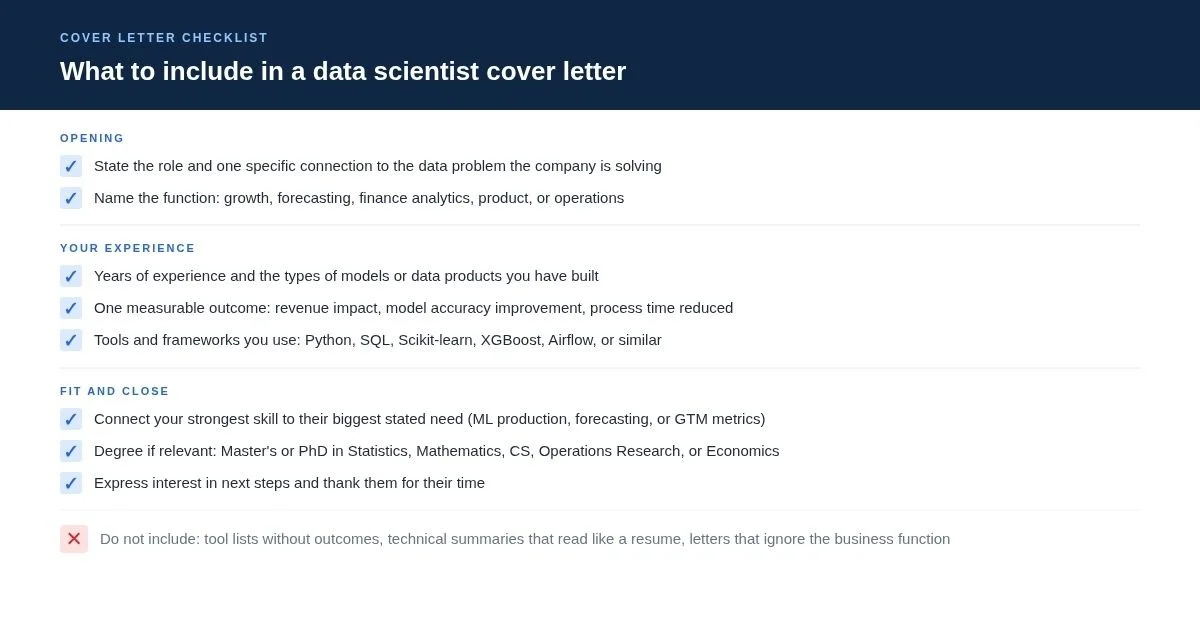
A strong letter has five parts. Keep each section tight.
Opening. State the role and one specific reason you want this position at this company. Connect to something visible in the posting, the type of data problem they are solving, the team structure, or the business function you would be embedded in.
Why this company. One or two sentences about something concrete: the product, the scale of the data challenge, or a specific technical detail from the posting. Data science hiring managers notice when candidates understand the actual problem they are being hired to solve, not just the job title.
Your experience. Two to three sentences covering your years in data science, the types of models or data products you have built, and a quantifiable result. Revenue impact, model accuracy improvement, process time reduced, cost saved.
Why you. Connect your strongest technical or analytical skill directly to their biggest stated need. If the posting emphasizes production ML and cross-functional stakeholder management, lead with that. If it emphasizes forecasting and planning cycles, lead with that instead.
Closing. Express interest in next steps, confirm availability, and thank them for their time. One short paragraph.
Most data scientist cover letters fail for one reason. They demonstrate technical knowledge without demonstrating business impact. Hiring managers need to know you can build the model, but they also need to know what changed because you built it. Specificity is what gets read. Keep that in mind as you use the template below.
Data scientist cover letter template
Data science roles attract technically strong candidates who often write letters that read as capability statements rather than impact statements. What separates the letters that get a response is the ability to connect a technical output to a business outcome. Each placeholder below is a prompt to think about what actually happened when you applied your skills, not just what your skills are.
Use this as your starting point. Replace every placeholder with specific details. A quick test before you send: if your letter still works when you replace the company name, it is too generic.
[Your Name] [City, State] [Email] | [LinkedIn URL]
Dear [Hiring Manager Name],
I am applying for the [Job Title] role at [Company Name]. With [X] years of data science experience focused on [growth / forecasting / finance / product analytics / relevant area], I have built a track record of [one key outcome, e.g., "translating complex ML outputs into revenue decisions that GTM teams can act on in their daily workflows"].
[Company Name]'s work on [specific detail from the posting, e.g., "product-led growth and cross-sell optimization for a developer-first SaaS platform" or "multi-horizon infrastructure demand forecasting for a hyper-growth cloud environment"] is exactly the kind of problem I find most interesting to work on. I was drawn to this role specifically because [one concrete reason this opportunity is distinct].
In my most recent role as [Your Title] at [Previous Company], I [specific project or model type]. I built [specific output], partnering with [stakeholders], and [measurable outcome, e.g., "increased lead-to-opportunity conversion by 18% by deploying a product-qualified lead scoring model that surface signals into the CRM in real time"].
I have expert-level proficiency in Python and SQL, hands-on experience with [specific ML framework], and [specific additional skill relevant to this role]. [Optional: I hold a Master's / PhD in [field] and have [X] years of applied experience in industry.]
I would welcome the opportunity to discuss how my background fits the work your team is doing. I am available at your convenience.
Thank you for your time and consideration.
[Your Name]
Data scientist cover letter examples
Data science roles vary enormously by function and environment. A staff data scientist on a GTM growth team at a SaaS company builds recommendation engines, lead scoring models, and revenue attribution frameworks that feed directly into Sales and Marketing workflows. A senior data scientist focused on forecasting at an infrastructure company builds multi-horizon demand models that inform capital expenditure and physical deployment decisions. The examples below reflect both profiles. The technical context differs, but the structure is the same: the problem, the model or framework built, and the outcome that followed.
Example 1: Staff data scientist, GTM and growth, SaaS
Nadia Okonkwo Austin, TX nadia.okonkwo@email.com | linkedin.com/in/nadiaokonkwo
Dear Hiring Manager,
I am applying for the Staff Data Scientist role at Meridian Communications. With eight years of data science experience in SaaS growth environments, I have spent the last four years focused specifically on GTM and revenue optimization, building the models and data products that help Sales and Marketing teams find the right opportunities at the right time.
Your mandate to revolutionize cross-sell and upsell initiatives through a product-led growth lens is the kind of problem I find most rewarding to work on. Bridging self-service product behavior with Sales-ready signals requires both statistical rigor and a deep understanding of how GTM teams actually work. I have done this successfully and I know where most organizations get it wrong.
At my current company, I led the development of a product-qualified lead scoring model that ingested usage signals, support interactions, and billing history to identify accounts with high upsell potential. The model deployed directly into Salesforce and Slack workflows, surfacing recommended next actions for account executives in the platforms where they already worked. Within two quarters of deployment, pipeline from PQL-sourced outreach increased by $4.2M and conversion from PQL to opportunity improved from 11% to 27%. I also built the incrementality framework that proved the model's true ROI beyond correlation -- which was what gave leadership the confidence to scale the investment.
I have expert-level proficiency in Python and SQL, deep experience with XGBoost and Scikit-learn in production environments, and strong working knowledge of GTM metrics including LTV, CAC, ARR, and pipeline velocity. I hold a Master's degree in Statistics and have worked closely with Marketing, Sales, and Finance teams throughout my career.
I would welcome the opportunity to learn more about the team and this mandate. Thank you for your consideration.
Nadia Okonkwo
Example 2: Senior data scientist, forecasting and infrastructure planning
Thomas Braun Denver, CO thomas.braun@email.com | linkedin.com/in/thomasbraun
Dear Hiring Manager,
I am applying for the Senior Data Scientist, Forecasting role at Vertex Cloud. With seven years of data science experience focused on demand forecasting and capacity planning in infrastructure and compute environments, I bring the multi-horizon modeling expertise and cross-functional planning experience your integrated planning team is looking for.
Infrastructure forecasting is a discipline where the stakes of being wrong are measured in capital. An underforecast means capacity constraints that affect customers. An overforecast means stranded assets and unnecessary expenditure. The models I build are designed to be wrong as infrequently as possible and to surface uncertainty clearly when they are. That is a different mindset than product analytics, and it is the one I have developed over seven years of building forecasting frameworks in high-complexity environments.
At my current company, I architected an end-to-end demand forecasting system for GPU and storage assets across four data center regions. The framework incorporates sales pipeline signals, product roadmap inputs, and utilization trends across both near-term and 18-month horizons, and feeds directly into capacity planning cycles and CapEx submissions. Before the framework existed, planning cycles relied on spreadsheet models updated manually by multiple teams. Post-deployment, forecast accuracy at the 90-day horizon improved by 31% and planning cycle time was reduced from three weeks to five days. I present forecast outputs and confidence intervals directly to senior leadership and the Finance team on a monthly basis.
I hold a PhD in Operations Research and have expert proficiency in Python, SQL, and time-series modeling frameworks. I have direct experience in S&OP and consensus-based planning environments and am comfortable translating quantitative outputs into capital allocation decisions for non-technical stakeholders.
I would be glad to discuss this role further. Thank you for your time.
Thomas Braun
Example 3: Data scientist, finance analytics, fintech
Priya Menon, Chicago, IL, priya.menon@email.com | linkedin.com/in/priyamenon
Dear Hiring Manager,
I am applying for the Senior Data Scientist role at Caldwell Financial. With six years of data science experience in financial services and fintech environments, I bring the SQL depth, financial data architecture fluency, and stakeholder communication skills your analytics team is looking for.
Finance analytics requires a different standard of rigor than most data science functions. The outputs feed directly into credit decisions, risk exposure calculations, and regulatory reporting. I have built my career around that standard, working in environments where model transparency and auditability are as important as predictive accuracy.
In my current role at a consumer lending platform, I built a credit risk segmentation model that replaced a rules-based underwriting framework the company had relied on for four years. The model incorporated bureau data, behavioral signals, and payment history across three product lines. After deployment, approval rates for prime borrowers increased by 14% with no corresponding increase in default rates, and the model reduced manual review volume by 40%. I presented the methodology and confidence intervals to the Chief Risk Officer and external auditors during the annual model validation review.
I have expert proficiency in Python and SQL, hands-on experience with XGBoost and Scikit-learn in production, and strong working knowledge of financial metrics including loss rates, LTV, and risk-adjusted return. I hold a Master's degree in Applied Statistics and have worked closely with Risk, Finance, and Compliance teams throughout my career.
I would welcome the opportunity to discuss how my background fits this role. Thank you for your time.
Priya Menon
Common mistakes to avoid
Listing tools without outcomes. "Proficient in Python, TensorFlow, and Spark" appears in nearly every data scientist cover letter. Add one sentence that says what you built and what it produced.
Writing a technical resume summary. A cover letter is not a second resume. It is a case for why you specifically are the right person for this specific problem. Every sentence should connect to the role.
Ignoring the function. A growth data scientist and a forecasting data scientist are solving fundamentally different problems. A letter that could work for either will resonate with neither. Show you understand the specific domain.
Forgetting the business half. Hiring managers for senior data science roles are not just evaluating technical depth. They are evaluating whether you can translate outputs into decisions. Include at least one sentence about stakeholder partnership or business impact.
Running long. One page. Four to five short paragraphs. Senior hiring managers read a lot of applications. A letter that is clear and efficient signals the same qualities they are hiring for.
One more step most candidates skip
Most candidates apply and wait. Senior data science roles move fast and hiring managers are fielding multiple strong candidates at once. The ones who get responses do not wait, they reach out directly to the hiring manager the same day they apply.
If your application is getting filtered before a human sees it, understanding how applicant tracking systems work is worth reading before you apply. And once you have submitted, knowing exactly how to follow up on a job application is often what separates the candidates who get a response from the ones who wait in silence.
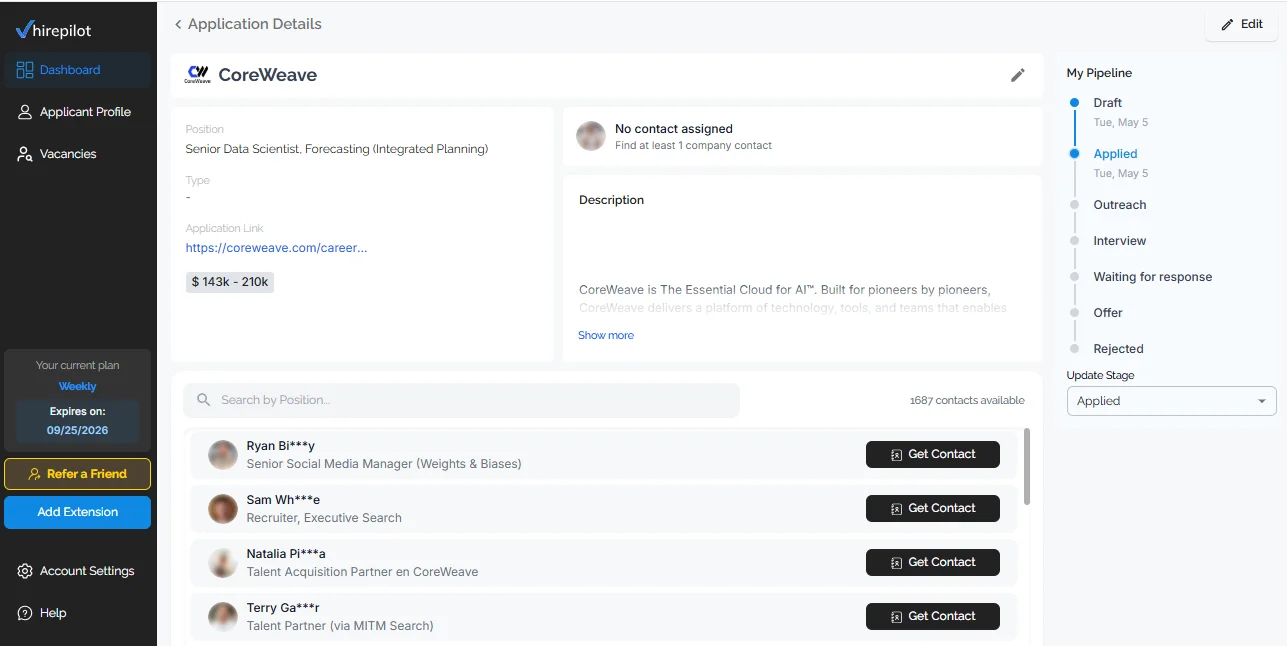
HirePilot handles both sides of that process. You autofill the application and the tool finds the hiring manager contact so you can send a personalized message the same day without spending an hour searching LinkedIn.
FAQ: Data scientist cover letter
What is a good data scientist cover letter?
A strong one connects technical output to business outcome. It names the models or frameworks you built, the stakeholders you partnered with, and at least one measurable result. It avoids generic tool lists and demonstrates that you understand the specific data problem the employer is trying to solve. One page, four to five paragraphs.
How long should a data scientist cover letter be?
One page. Aim for 350 to 450 words. Senior data science roles attract technically strong candidates. The cover letter is your opportunity to demonstrate that you can communicate complex work clearly and concisely, a skill the role requires every day.
Should I mention my degree in a data scientist cover letter?
Yes, if you have a graduate degree in a quantitative field. For senior and staff-level roles especially, a Master's or PhD signals statistical depth that is hard to infer from experience alone. Mention it once, briefly. If your degree is in a non-quantitative field, lead with your applied experience and relevant certifications instead.
What is the best way to open a cover letter for a data scientist role?
Start with the role name and one specific connection to the type of data problem the company is solving. Avoid "I am writing to express my interest." Lead with something concrete about your experience in this specific domain, GTM, forecasting, finance analytics, or whichever function matches the role.
Do data scientists still need cover letters?
For most senior and staff-level roles, yes. Even when listed as optional, a well-written cover letter that demonstrates business impact alongside technical depth is often what distinguishes a candidate in a competitive field.
Find your next job faster - without the chaos
Spend minutes, not hours, on applications. Stay organized, follow up confidently, and get noticed sooner.
Share this article

Viktor Shumylo
Viktor Shumylo is the co-founder of HirePilot, an AI-powered job search platform. He has 10+ years of experience building SaaS products and tools that help job seekers optimize resumes, streamline applications, and land interviews faster.
More articles by Viktor Shumylo