



You found a finance role that fits, the company is right, the scope matches your background, the compensation range works. You open the application and hit the cover letter field.
Most candidates write something that starts with "I am a detail-oriented finance professional with a strong background in financial analysis." That sentence could belong to anyone. It tells the hiring manager nothing about you specifically, and nothing about why you want this role at this company.
Finance roles require precision, analytical thinking, and the ability to communicate complex data clearly. Your cover letter is the first place you demonstrate all three. This guide gives you a ready-to-use finance cover letter template, two realistic examples, and the key skills hiring managers look for.
Skills needed for a finance role
Hiring managers are not scanning for everything on this list. They are looking for two or three skills that match their exact problem. These are the ones that appear most consistently across current finance postings.
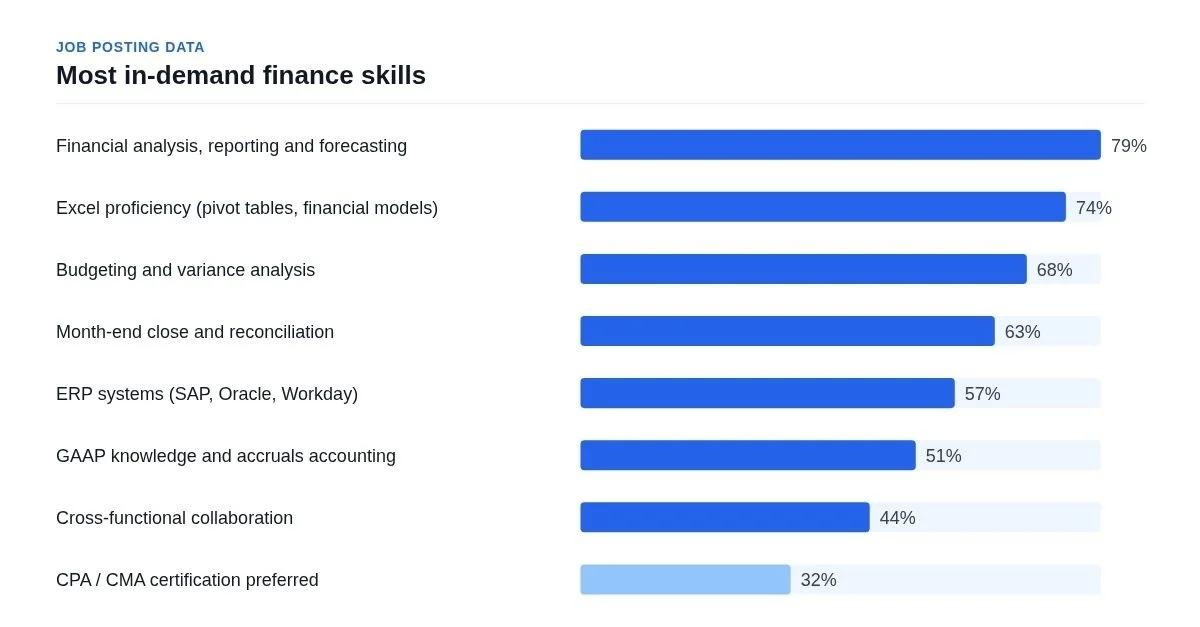
Technical and analytical skills:
- Financial analysis, reporting, and forecasting
- Budgeting and variance analysis
- Proficiency in Excel (advanced, including pivot tables and financial models)
- ERP systems experience (SAP, Oracle, Workday, or similar)
- Month-end close and reconciliation processes
- GAAP knowledge and accruals accounting
- Payroll accounting or cost accounting depending on the role
Soft skills and communication:
- Translating financial data into clear recommendations for non-finance stakeholders
- Managing competing deadlines across multiple business partners
- Cross-functional collaboration with operations, engineering, or HR teams
- Attention to detail and accuracy under time pressure
Pick two or three that match the specific posting and build your letter around those.
Certifications worth mentioning
If you hold a CPA (Certified Public Accountant) or CFA (Chartered Financial Analyst), mention it once in the body of your letter. Both carry significant weight with hiring managers and signal technical depth.
Other credentials worth a brief mention if relevant:
- CMA (Certified Management Accountant) for FP&A and cost accounting roles
- MBA with finance concentration for senior or strategic finance positions
- Series 7 or Series 63 for roles with investment or advisory components
One sentence is enough. The resume expands on it. The cover letter just signals you have it.
What to include in a finance cover letter
A strong letter has five parts. Keep each section tight.
Opening. State the role and one specific reason you want this position at this company. Connect to something visible in the job description or their industry.If you cannot write something specific here, research the company first.
Why this company. One or two sentences about something concrete: the scale of their operations, a transformation initiative, or a specific financial challenge tied to their business. This shows you did the work. "I have always admired your company" is not a reason. Reference something real.
Your experience. Two to three sentences covering your years in finance, the types of analyses or processes you have owned, and a quantifiable result. Forecasts improved, close cycle shortened, variance identified. A letter without a number reads as vague regardless of what it claims.
Why you. Connect your strongest skill directly to their biggest stated need. If the posting emphasizes variance analysis and cross-functional partnership, lead with that. Do not repeat your resume. Pick one skill and connect it directly to what they asked for.
Closing. Express interest in next steps, confirm availability, thank them for their time. One short paragraph. Do not add new information here.
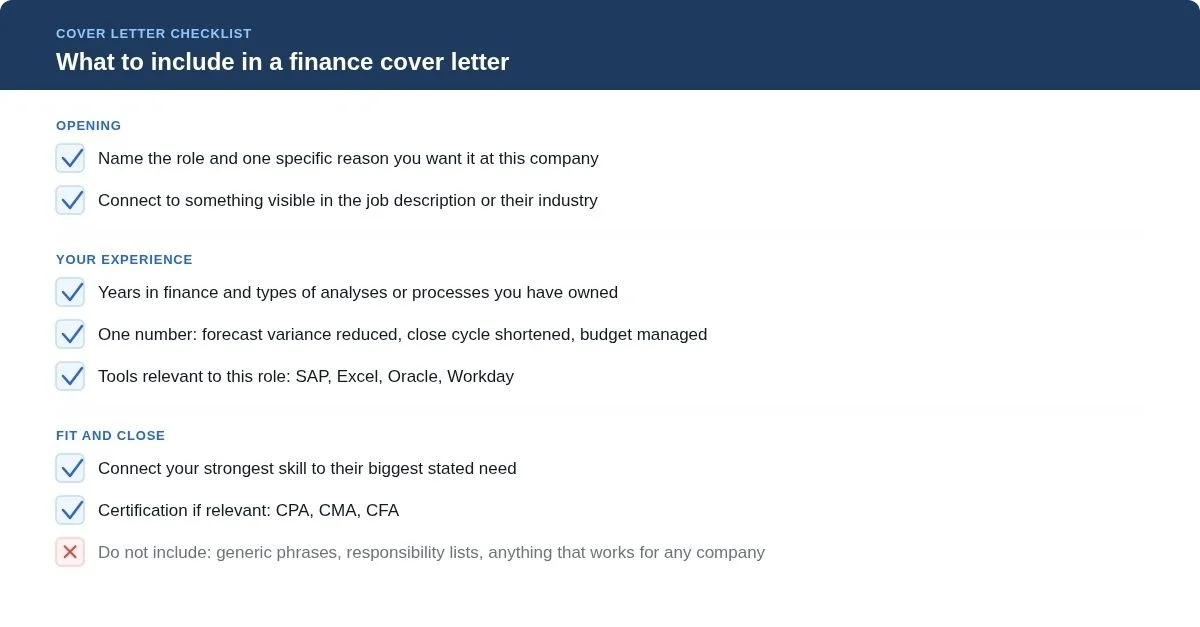
Most finance cover letters fail for one reason. They describe what the candidate has done without showing what the candidate can solve. Specificity is what gets read. Keep that in mind as you use the template below.
Finance cover letter template
Finance roles attract candidates with strong technical backgrounds who often write letters that read like a list of competencies. What separates the letters that get a response is not the credentials -- it is the ability to connect those credentials to a specific business problem. Use the placeholders below as prompts, not fillers. Each bracket should force you to think about this company, not your last one.
Use this as your starting point. Replace every placeholder with specific details. A quick test before you send: if your letter still works when you replace the company name, it is too generic.
[Your Name] [City, State] [Email] | [LinkedIn URL]
Dear [Hiring Manager Name],
I am applying for the [Job Title] role at [Company Name]. With [X] years of experience in [financial analysis / FP&A / payroll accounting / relevant area], I have developed a strong track record in [one key area, e.g., "supporting monthly close processes, variance analysis, and cross-functional forecasting in a fast-moving manufacturing environment"].
[Company Name]'s focus on [specific detail from the posting or company background] aligns closely with the work I have been doing at [Current/Previous Company]. I was drawn to this role in particular because of [specific detail that makes this opportunity distinct].
In my most recent role as [Your Title] at [Previous Company], I [specific achievement with context]. I [specific responsibility], working closely with [stakeholders], and [measurable outcome, e.g., "reduced forecast deviation by 12% by introducing a revised assumption-validation process with operations partners"].
I hold [CPA/CMA/relevant certification] and have hands-on experience with [SAP/Excel/relevant tool]. I am confident in my ability to [connect directly to their stated need].
I would welcome the opportunity to discuss how my background aligns with this role. I am available at your convenience.
Thank you for your time and consideration.
[Your Name]
Finance cover letter examples
Finance roles span a wide range of functions -- FP&A, payroll accounting, cost analysis, treasury, and more. The examples below reflect two common but distinct profiles: a senior analyst in healthcare manufacturing and a finance and payroll analyst in a global tech environment. The specifics differ, but the structure is the same. Numbers, stakeholders, and a direct connection to the role's core need.
Example 1: Senior financial analyst, healthcare
Elena Marsh San Francisco, CA elena.marsh@email.com | linkedin.com/in/elenamarsh
Dear Hiring Manager,
I am applying for the Senior Financial Analyst role at Clearview Health Systems. With six years of financial analysis experience in healthcare and medical device manufacturing, I bring a strong foundation in cost variance analysis, month-end close processes, and cross-functional forecasting that directly maps to the responsibilities outlined in your posting.
Your focus on third-party manufacturing operations and the need to partner closely with operations and engineering teams is exactly the kind of environment I work in today. The combination of standard cost-setting, capital expense forecasting, and P&L consolidation is where I have built the most depth in my career.
In my current role, I support a global manufacturing finance team across four production sites. I led the annual standard cost-setting process for 200-plus SKUs, reduced prepaid inventory forecast variance by 18% through a revised assumption model, and built a monthly capital review deck used by the VP of Operations. I work daily in SAP and have advanced Excel skills including financial modeling and scenario analysis.
I hold a CPA license and a BS in Accounting. I bring both the technical depth and the cross-functional communication skills to contribute from day one.
I would welcome the opportunity to learn more about this role. Thank you for your consideration.
Elena Marsh
Example 2: Finance and payroll analyst, technology
Daniel Osei Austin, TX daniel.osei@email.com | linkedin.com/in/danielosei
Dear Hiring Team,
I am applying for the Finance and Payroll Analyst role at Nexara Technologies. With four years of experience at the intersection of payroll operations and financial accounting, I bring the technical precision and cross-functional collaboration skills your team is looking for in this role.
Your focus on international payroll, month-end close, and partnership with third-party vendors reflects the scope of work I have been managing for the past two years. I understand the stakes involved in payroll accounting accuracy, and I take ownership of that process seriously.
In my current role, I manage monthly payroll instructions for vendors across three APAC regions, own the balance sheet reconciliation for all payroll accounts, and prepare variance analysis for leadership review. Last year I identified a recurring mapping error between pay codes and general ledger accounts that had caused a $140K discrepancy across two quarters. I resolved the issue, documented the fix, and built a monthly audit control that has prevented recurrence since.
I have hands-on experience with SOX compliance controls for payroll processes, cash forecasting, and year-end documentation. I work closely with Treasury, HR, and cross-functional M&A integration teams and am comfortable managing competing priorities under tight close deadlines.
I would be glad to speak further about this role. Thank you for your time.
Daniel Osei
Example 3: Entry-level finance, recent graduate
Marcus Webb Chicago, IL marcus.webb@email.com | linkedin.com/in/marcuswebb
Dear Hiring Team,
I am applying for the Junior Financial Analyst role at Clearfield Partners. My background is in accounting and finance, and I am looking for a first role where I can apply what I have built academically and through internship experience in a real financial environment.
Your focus on financial reporting and cross-functional analysis caught my attention specifically. During my internship at a regional accounting firm, I supported month-end close for three client accounts, prepared variance reports in Excel, and flagged a recurring accrual error that had been understating expenses by approximately $8,000 per quarter. My supervisor escalated the finding to the client and it was corrected in the following close cycle.
I have strong Excel skills including pivot tables and basic financial modeling, working knowledge of GAAP principles, and hands-on experience with QuickBooks and SAP from coursework and internship work. I am detail-oriented, comfortable with repetitive high-accuracy tasks, and I ask questions early rather than guessing.
I am a fast learner and I am ready to contribute from day one on the tasks that matter most to your team right now.
I would welcome the opportunity to speak about this role. Thank you for your time and consideration.
Marcus Webb
Common mistakes to avoid
Starting with a summary of your resume. "I have five years of experience in financial planning and analysis" is a resume headline. Open with something specific to this company and this role.
Describing responsibilities instead of outcomes. "I was responsible for variance analysis" tells the reader nothing. "I reduced forecast variance by 15% by rebuilding the assumptions model" tells them something real.
Using the same letter for every application. Finance roles vary significantly across industries, company sizes, and functions. A letter for a corporate FP&A role reads differently than one for a payroll accounting position in a tech company.
Ignoring the business context. Hiring managers notice when candidates reference the company's actual challenges. One sentence that shows you read the posting carefully does more than three paragraphs of generic claims.
Running long. One page. Four to five short paragraphs. Anything beyond that belongs on the resume.
One more step most candidates skip
Most candidates submit their application and wait. That waiting is where most job searches stall.
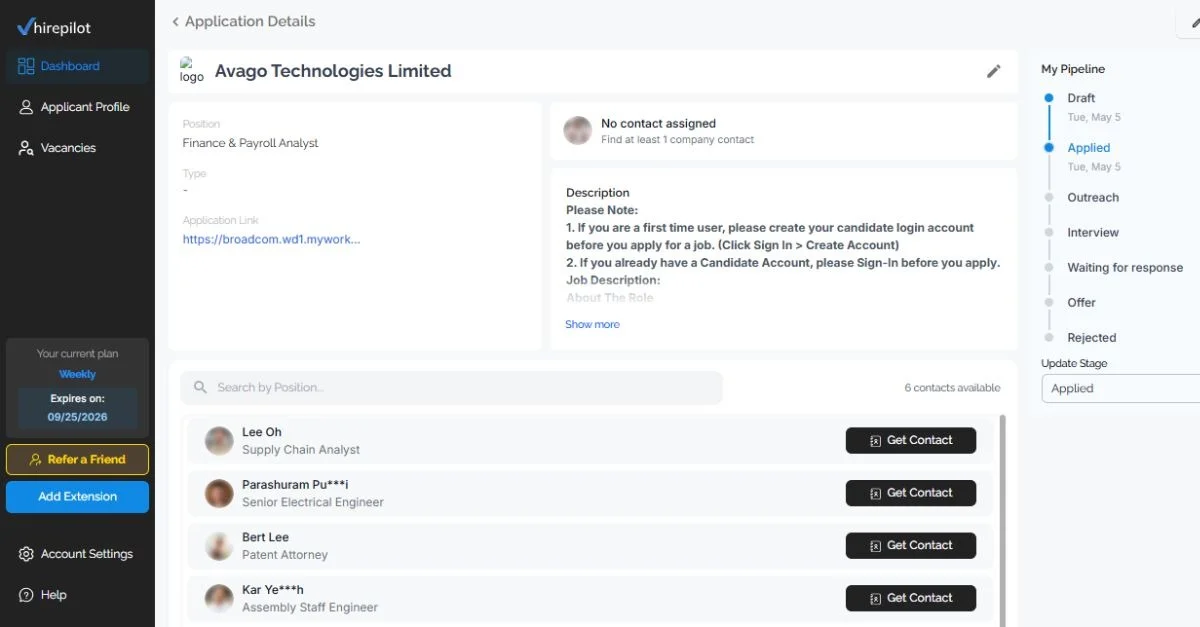
Candidates who get more interviews treat the application as the first step, not the last. They reach out directly to the hiring manager the same day they apply. Understanding how ATS systems filter applications before a human sees them is the first part of that equation. Knowing how to follow up after you apply is the second.
HirePilot handles both sides of that process in one workflow. You autofill the application form, and the tool finds the hiring manager so you can send a personalized message the same day, without spending an hour on LinkedIn research.
FAQ: Finance cover letter
What is a good finance cover letter?
A strong one is specific, short, and focused on what you have delivered. It connects your experience directly to the role's stated needs, includes at least one measurable result, and avoids generic phrases. One page, four to five paragraphs.
How long should a finance cover letter be?
One page. Aim for 300 to 400 words. Finance roles require clear and precise communication. A letter that runs long works against you before the reader even gets to your resume.
Should I mention CPA or CFA in a cover letter?
Yes, if you have either. Mention it once, briefly, in the body of the letter. Both credentials carry significant weight and signal technical commitment. CMA is worth mentioning for cost accounting and FP&A roles specifically.
What is the best way to open a cover letter for a finance role?
Start with the role name and one specific reason you want this position at this company. Avoid "I am writing to express my interest." Lead with something concrete about the financial function you support or a specific detail about their operations that makes your application distinct.
Do finance professionals still need cover letters?
For most mid-level and senior roles, yes. Even when listed as optional, submitting one signals the attention to detail and communication skills that every finance role requires. For senior FP&A or controller-track positions, a well-written letter often determines who gets the first interview call.
Find your next job faster - without the chaos
Spend minutes, not hours, on applications. Stay organized, follow up confidently, and get noticed sooner.
Share this article

Viktor Shumylo
Viktor Shumylo is the co-founder of HirePilot, an AI-powered job search platform. He has 10+ years of experience building SaaS products and tools that help job seekers optimize resumes, streamline applications, and land interviews faster.
More articles by Viktor Shumylo