


You applied to 30 jobs last month. You know you did because you remember doing it. But ask yourself: where did you apply, on which day, what was the status of each one, and who did you follow up with? If the answer involves opening four browser tabs and a spreadsheet from three weeks ago, your search is already working against you.
That is not a discipline problem. It is a system problem. And a job search assistant is what changes it.
What is a job search assistant?
A job search assistant is a digital tool, usually powered by automation and AI, that helps candidates manage the most time-consuming parts of the search process in one place.
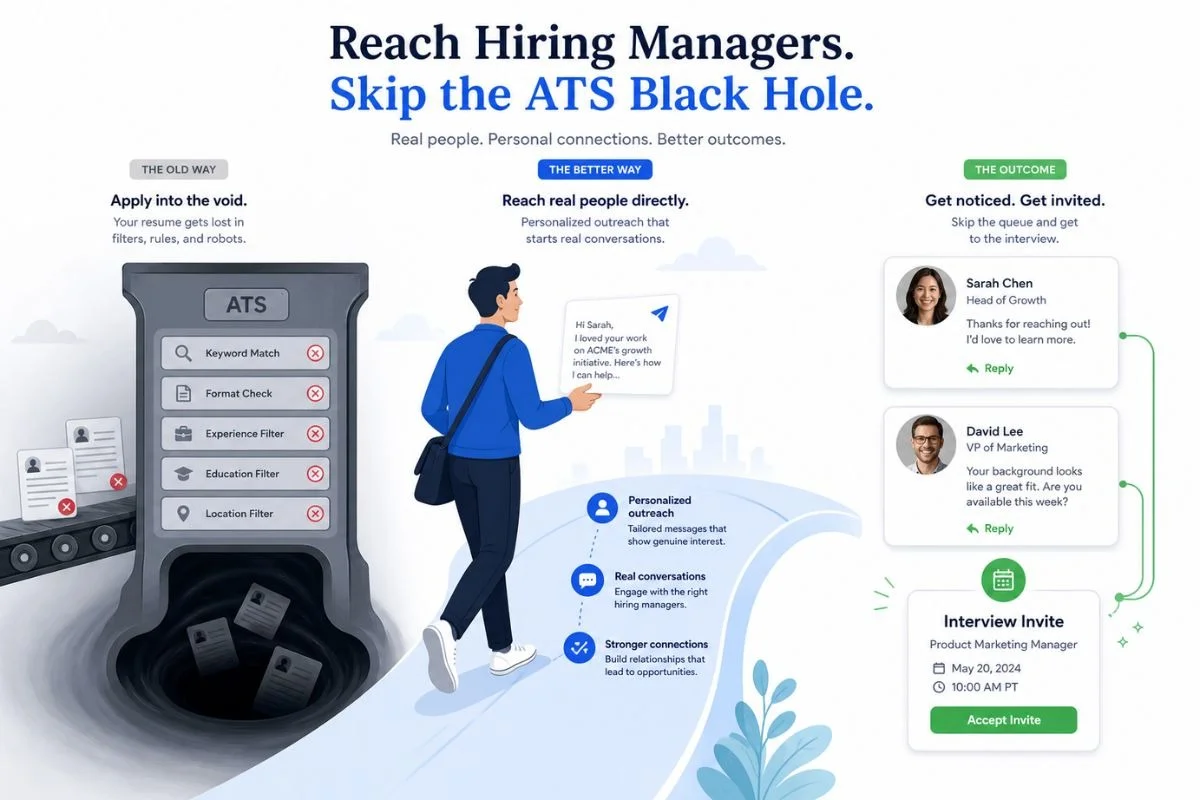
In practice, that means handling things like job discovery across multiple boards, saving and organizing roles, filling out repetitive application forms, tracking every submission, managing follow-up reminders, and helping candidates reach hiring managers with personalized outreach, instead of relying entirely on an ATS submission.
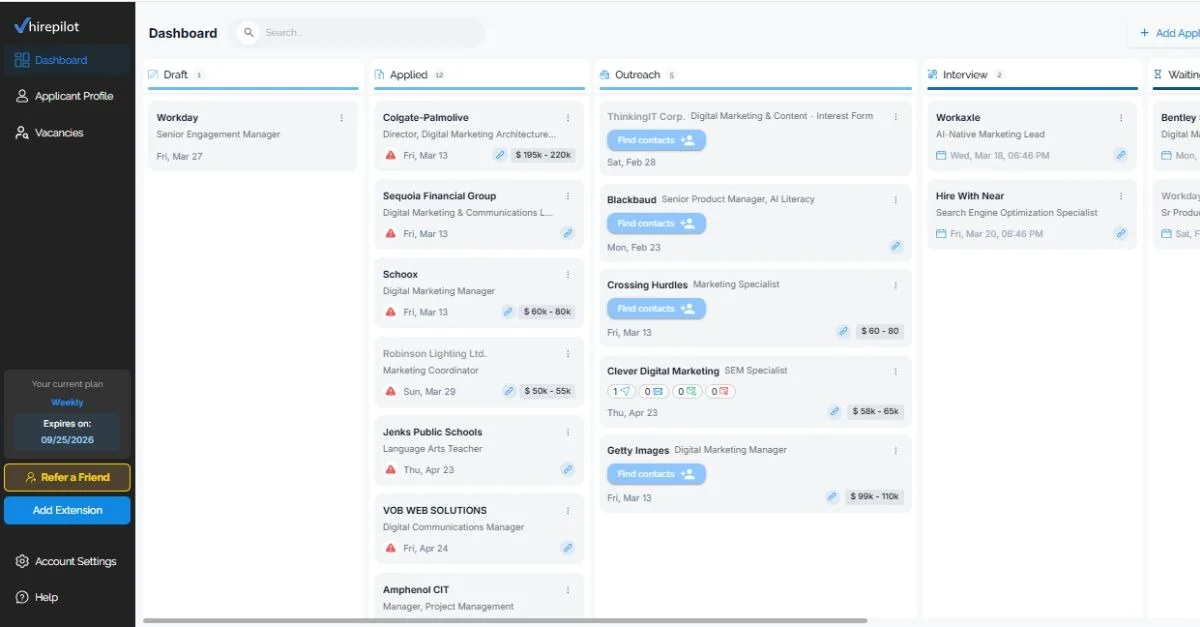
The key word is "manage." A job search assistant does not replace your judgment. It removes the admin friction that gets in the way of it.
Why the category matters now
The numbers are not working in your favor if you are searching the traditional way.
According to the U.S. Bureau of Labor Statistics, job openings sat at 6.9 million in early 2026, but the hiring rate dropped to its lowest point since April 2020. Employers are posting. They are just not filling roles quickly. That means more competition per opening, longer wait times, and more candidates in every shortlist.
Research from Harvard Business School's managing the future of work project found that the average corporate job opening attracts over 250 applications, and that most resume screening now happens before a recruiter ever reads the file. Applying more does not solve this. Applying smarter does.
Understanding what makes AI job search tools actually effective starts with knowing what part of the process you are actually trying to fix.
The core problem it solves
Most candidates do not struggle because they are unqualified. They struggle because the process is fragmented and exhausting in ways that are easy to underestimate until you are three months in.
Each problem below has a specific shape. And each one quietly damages your chances in a different way.
| Problem | What it looks like in real life | Why it hurts your chances |
|---|---|---|
| Repetitive applications | Re-entering the same name, history, and contact details into every form | Slows application volume and creates fatigue that compounds over time |
| Disorganized tracking | Spreadsheet tabs, saved jobs in bookmarks, email flags, sticky notes | Causes missed follow-ups and duplicate effort across roles |
| Scattered job discovery | Searching LinkedIn, Indeed, Workday, and company sites separately with no central view | Makes it harder to compare, prioritize, and act on the right opportunities |
| Weak follow-up habits | Forgetting who to contact and when, or not having a process at all | Reduces visibility after you apply, exactly when it matters most |
| ATS dependency | Relying only on application portals and waiting | Limits your exposure to the real people making hiring decisions |
| Burnout | Endless admin work with little feedback or visible progress | Lowers consistency and makes it harder to sustain momentum over a long search |
A job search assistant exists to solve these workflow problems, not by replacing your judgment, but by removing the friction that makes good judgment harder to act on.
What a job search assistant actually does
Centralizes job discovery
Instead of manually checking multiple boards every day, a good assistant pulls everything into one dashboard. You see roles from different sources, compare them side by side, and decide where to spend your energy, without losing track of what you already looked at.
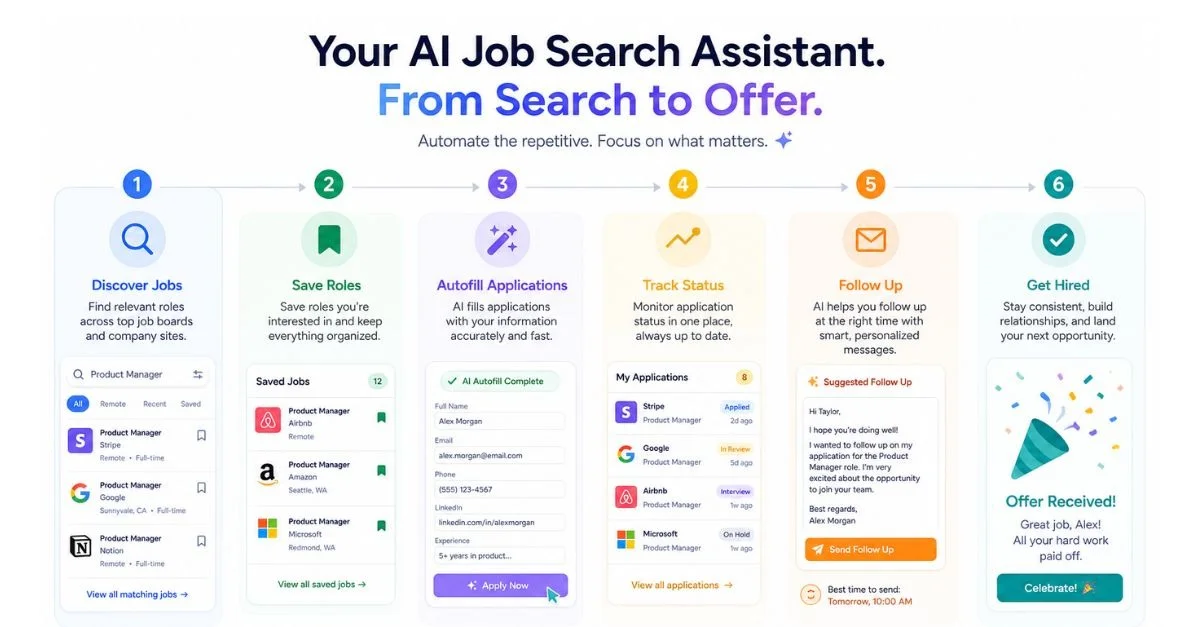
Scattered discovery leads to duplicate effort, missed deadlines, and a search that feels busy without moving forward. Getting clear on how to apply for a job online in a way that actually produces responses starts with having all your opportunities in one organized place, not spread across a dozen open tabs.
Speeds up applications with autofill
One of the biggest time drains in job hunting is retyping the same information over and over. Every platform wants your work history, your education, your contact details, and a dozen standard answers. You enter them all again. And again.
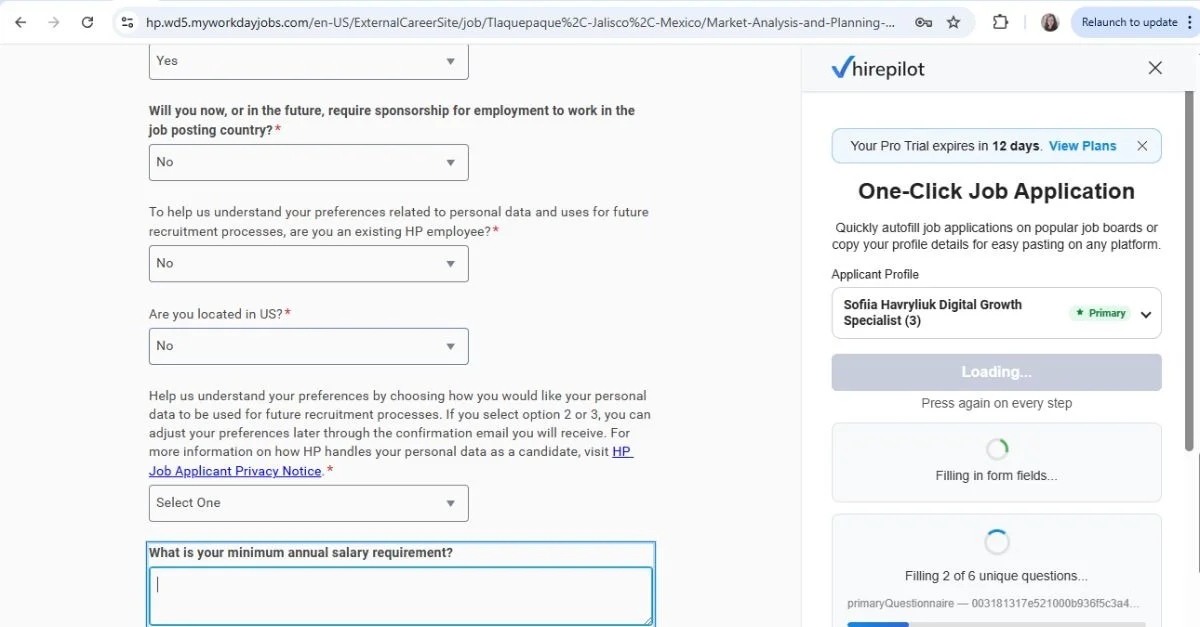
Application autofill uses your saved profile data to fill those fields faster. That is not just a time-saver. It reduces the friction at the exact moment candidates slow down or give up. HirePilot's 1-click autofill works across LinkedIn Easy Apply, Indeed, and Workday, and the full picture of how application autofill works and where it saves the most time
⚡ The average job application takes 40–50 minutes
With 1-click autofill that drops to under 5 minutes. The difference compounds fast when you are applying to 20 or more roles in a month.
Tracks every application in one place
Applying is not the end of the process. It is the beginning. What happens after the submission, whether you follow up, when you follow up, and how you track the conversation, often determines whether your application stays alive or disappears.
A job search assistant keeps that record for you: where you applied, when, what resume version you used, what the status is, and what the next action should be. The difference between this and a spreadsheet is that a good tracker prompts you instead of waiting to be updated.
Supports outreach to hiring managers
This is the part most advice articles skip entirely.
Submitting through an ATS is one path. Reaching the person who actually makes the hiring decision is another. Candidates who do both, apply through the official channel and send a short, relevant message to the right contact the same day, consistently report better response rates than those who rely on the form alone.
The reason is simple. A personalized message puts a face on your application before it enters a system where it competes with 200 other profiles. What that message should actually say, and how to structure outreach that gets replies, is the core of running an AI recruiter outreach campaign step by step.
HirePilot's AI-assisted outreach helps users find the right contact for a role and draft a message worth sending, without starting from a blank page every time.
Reduces mental load over time
This one is rarely talked about, but it matters in a long search.
When your process is scattered, every session starts with re-orientation. You spend the first 15 minutes figuring out where you left off before you can actually make progress. Over weeks, that accumulates into fatigue that looks like lack of motivation but is actually a system problem.
A centralized assistant means you log in and immediately see your priorities, your pending follow-ups, and your next actions. That clarity keeps momentum up in a search that might otherwise stall.

How it differs from a job board
Job boards are discovery engines. They are useful and necessary, but they are one layer of the process.
| Feature | Job board | Job search assistant |
|---|---|---|
| Find open roles | Yes | Yes |
| Save and organize roles | Sometimes | Yes |
| Autofill applications | Rarely | Yes |
| Track status and next steps | No | Yes |
| Follow-up reminders | No | Yes |
| Outreach to hiring managers | No | Often supported |
| Workflow across multiple boards | No | Yes |
The distinction matters because most candidates treat their job board as their whole system. It is not. It is the first step in a workflow that needs to continue well past the moment of submission.
The signature insight: your search needs a pipeline, not a pile
Here is what most advice on job searching misses.
Salespeople do not track leads in their memory. Recruiters do not manage candidates in browser bookmarks. They use pipelines, structured systems that show where every opportunity is, what the next step is, and what is falling behind.
Job seekers are running the same kind of high-volume, multi-stage process, but most do it without any of the infrastructure that makes it manageable.
A job search assistant gives you that pipeline. Not to automate your judgment, but to support it. You still decide which roles fit. You still write the messages. You still show up to interviews. The assistant handles the tracking, the reminders, and the repetitive form-filling so that energy goes where it actually counts.
LinkedIn's Global Talent Trends data shows that hiring rates have slowed across most industries while the volume of applicants per role has increased. In that environment, standing out depends less on applying more and more on following up faster and more consistently. That kind of follow-through requires a system.
What to look for in a job search assistant
Not every tool labeled a job search assistant is equally useful. The ones that are worth your time tend to do a few things well.
Accurate, reliable autofill. Autofill that creates more cleanup work than it saves is not useful. The tool should handle common application platforms without constant correction.
A real tracking dashboard. Status labels, notes by role, reminder scheduling, and filtering by stage. A simple list of where you applied is not enough.
Built-in outreach support. The ability to identify a hiring manager and send a relevant message is increasingly the differentiator between candidates who get responses and those who do not.
Low friction for daily use. If the tool feels like a project to maintain, you will stop using it. The best ones feel like relief.
Multi-platform coverage. Your search spans more than one site. Your assistant should too.
Signs you need one now
If any of these are true, you are working harder than you need to:
- You cannot remember where you applied last week
- Your search lives across tabs, emails, and a spreadsheet that is three updates behind
- You keep retyping the same information into every form
- You forgot to follow up with someone and only remembered when you found the email by accident
- You save jobs but rarely come back to them
- You want to reach out to recruiters but do not have a process for it
These are not signs of poor effort. They are signs of a search running without proper infrastructure. The fix is not to work harder. It is to build a better system.
How HirePilot fits into this
HirePilot is built around the idea that a job search should function like a pipeline, not a pile of browser bookmarks and half-updated spreadsheets.
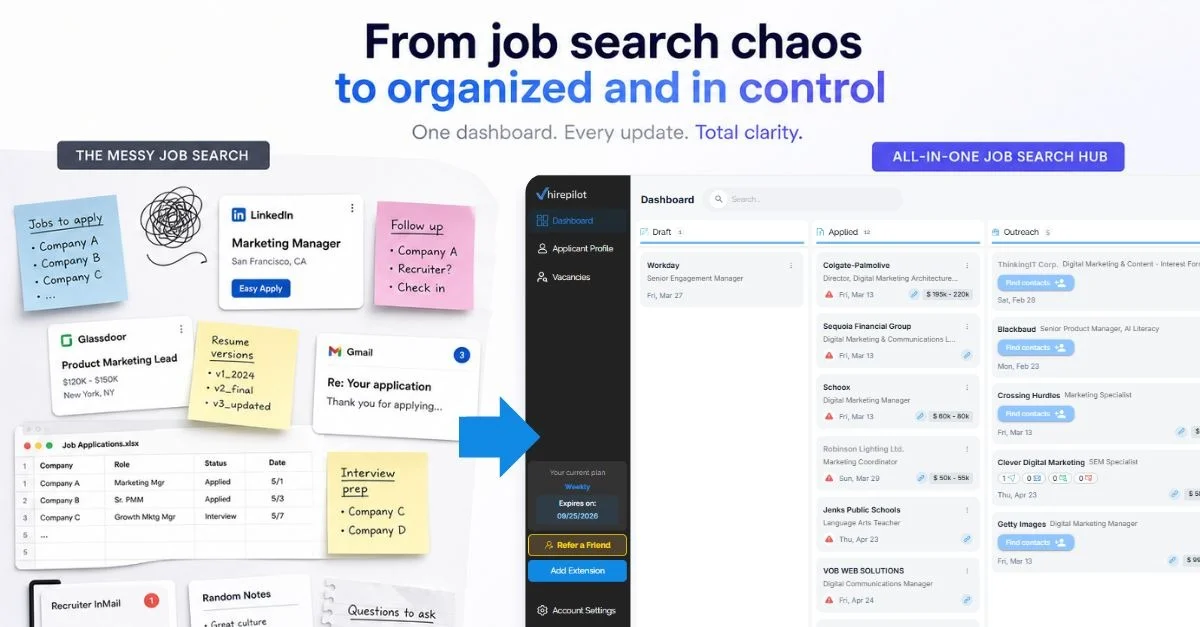
It combines the parts that matter into one workflow: centralized job discovery, 1-click autofill across LinkedIn, Indeed, and Workday, automatic application tracking when you apply, status management and reminders, and AI-assisted outreach to help you reach the hiring manager on the same day you submit.
The outreach feature is the part that separates it from a standard autofill tool. Most job search tools help you fill forms faster. HirePilot also helps you get in front of the person behind the form, which is where the actual hiring decision lives.
If your search feels busy but not productive, the infrastructure is usually what needs to change first.
FAQ: Job search assistant: what it does
What is a job search assistant?
A job search assistant is a tool that helps candidates manage the most time-consuming parts of the search process, including job discovery, application autofill, status tracking, follow-up reminders, and recruiter outreach. The best ones bring these functions into one connected workflow rather than treating them as separate tasks.
What does an AI job search assistant do?
An AI job search assistant uses automation and machine learning to speed up repetitive tasks like form-filling and to support more strategic ones like drafting personalized outreach messages. The goal is to remove admin friction so candidates can focus on the parts of the search that require actual judgment.
Is a job search assistant worth using?
For active job seekers managing multiple applications across different platforms, yes. The time saved on repetitive data entry, the clarity provided by organized tracking, and the follow-up support that most candidates skip can all meaningfully improve how a search runs, especially over weeks or months.
How is a job search assistant different from a job board?
A job board helps you find openings. A job search assistant helps you manage everything that happens after you find them, from applying to tracking to following up. They are different tools that work best together, not interchangeable.
What is the best way to organize a job search?
The most effective approach is to treat the search like a pipeline: save promising roles in one place, apply with consistent and well-matched materials, track every submission with notes and next steps, and follow up with the right person at the right time. A job search assistant supports each of those steps so none of them get dropped.
How do I automate my job search without losing personalization?
Automation works best on the repetitive parts: form-filling, status tracking, reminder scheduling, and initial outreach drafts. The personalization comes in the final review, the message edits, and the human judgment about which roles to pursue. The goal is to automate the admin, not the thinking.
Find your next job faster - without the chaos
Spend minutes, not hours, on applications. Stay organized, follow up confidently, and get noticed sooner.
Share this article

Viktor Shumylo
Viktor Shumylo is the co-founder of HirePilot, an AI-powered job search platform. He has 10+ years of experience building SaaS products and tools that help job seekers optimize resumes, streamline applications, and land interviews faster.
More articles by Viktor Shumylo