


You have managed a 200-unit community through a renovation. You have resolved maintenance emergencies at midnight, coached a leasing team through a slow quarter, and held occupancy above 95% while the market softened. Then you sit down to write a cover letter and it comes out sounding like a job description.
Most property manager cover letters read like a list of responsibilities. "Responsible for overseeing daily operations, managing staff, and maintaining resident satisfaction." Every candidate says this. The hiring manager, who is usually a regional manager with a full portfolio, has read it a hundred times.
What works is showing what you did with those responsibilities. The occupancy rate you maintained. The NOI improvement you drove. The team you built from a difficult starting point. That specificity is what separates a property manager cover letter that gets a callback from one that gets skipped.
This guide gives you the structure, a ready-to-use template, and two realistic examples you can adapt today.
Skills needed for a property manager
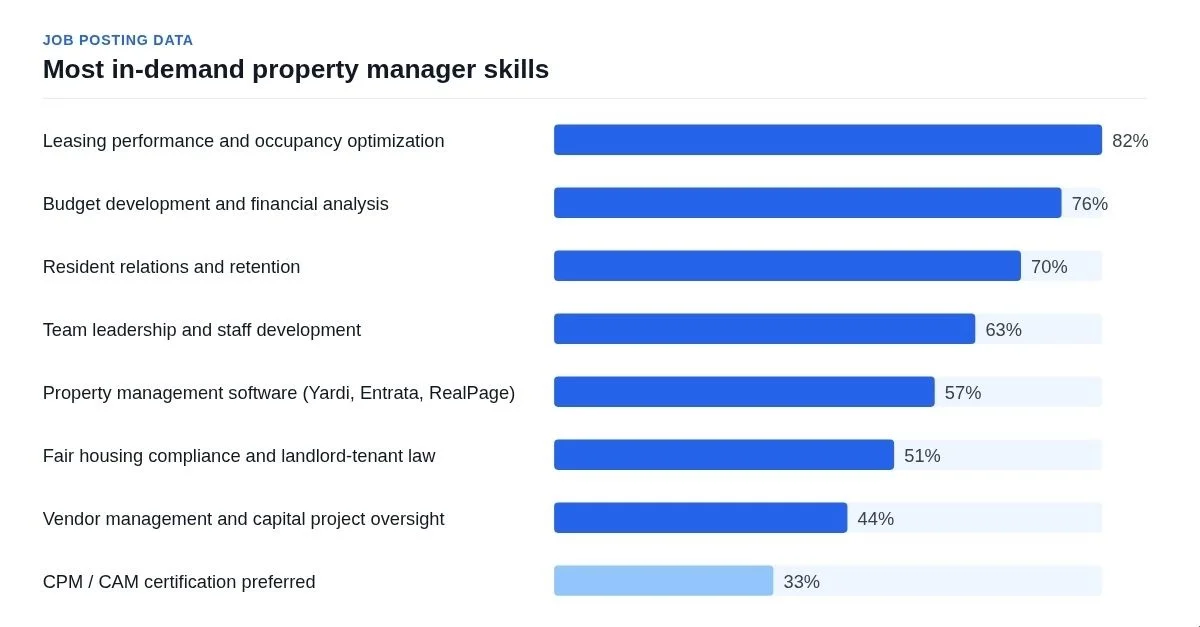
Hiring managers are not scanning for every skill on this list. They are looking for two or three that match the specific property type, size, and ownership structure they are hiring for. These are the ones that appear most consistently across current postings.
Operations and financial skills:
- Budget development and financial statement analysis
- NOI management and variance analysis
- Leasing performance and occupancy optimization
- Vendor management and contract review
- Capital project oversight and coordination
- Fair housing compliance and landlord-tenant law
- Property management software proficiency (Entrata, Yardi, RealPage, or similar)
- Rent collection, reporting, and accounts payable oversight
Leadership and resident relations skills:
- Recruiting, onboarding, and developing leasing and maintenance staff
- Performance coaching and team accountability
- Resident retention strategies and satisfaction programs
- Conflict resolution and resident complaint management
- Market analysis and competitive positioning
- Inspections, make-ready oversight, and preventative maintenance management
The specific skills that matter most depend on the property type. A Class A market-rate community in a major metro needs strong leasing strategy and financial acumen. An affordable housing property with LIHTC or HUD compliance needs deep regulatory knowledge and documentation discipline. Read the posting carefully and lead with what they have emphasized most.
Certifications worth mentioning
If you hold a CPM (Certified Property Manager) from the Institute of Real Estate Management, mention it. It is the most recognized credential in the industry and signals professional commitment at a senior level.
Other credentials worth a brief mention if relevant:
- CAM (Certified Apartment Manager) from NAA -- widely recognized for multi-family roles
- ARM (Accredited Residential Manager) from IREM -- strong for mid-level and residential-focused positions
- HCCP (Housing Credit Certified Professional) or similar for affordable housing and LIHTC properties
- Fair housing certifications for compliance-heavy environments
One sentence is enough in the cover letter. The resume expands on it.
What to include in a property manager cover letter
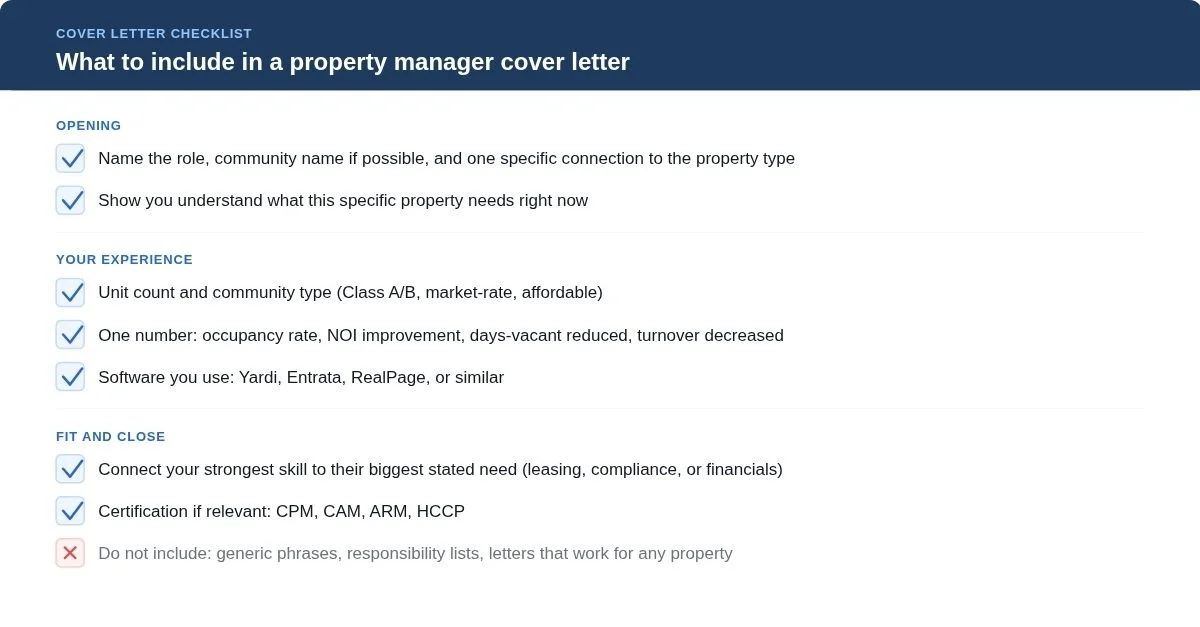
A strong letter has five parts. Keep each section tight.
Opening. State the role and one specific connection to this company or property type. Regional managers notice when a candidate references the actual community, the unit count, or a specific operational detail from the posting.
Why this company. One or two sentences about something concrete: the ownership group's reputation, the property's renovation status, the portfolio size, or a management philosophy visible in the posting. Property management is a relationship-driven industry. Show you did the homework.
Your experience. Two to three sentences covering your years in property management, the types and sizes of communities you have managed, and one quantifiable result. Occupancy rate achieved, NOI improvement driven, team size led.
Why you. Connect your strongest skill directly to their biggest stated need. If the posting emphasizes financial performance and leasing strategy, lead with that. If it emphasizes affordable housing compliance and resident relations, lead with that instead.
Closing. Express interest in next steps, confirm availability, thank them for their time. One short paragraph.
Most property manager cover letters fail for one reason. They describe a job, not a performance. Regional managers are not looking for someone who can do the duties. They are looking for someone who can move numbers. Specificity is what gets read. Keep that in mind as you use the template below.
Property manager cover letter template
Property management is a results-driven field and hiring managers evaluate candidates the same way they evaluate property performance -- by the numbers. Each placeholder below is a prompt to think about what you have actually delivered, not just what you were responsible for.
Use this as your starting point. Replace every placeholder with specific details. A quick test before you send: if your letter still works when you replace the property name, it is too generic.
[Your Name] [City, State] [Email] | [LinkedIn URL]
Dear [Hiring Manager Name],
I am applying for the Property Manager role at [Company Name]. With [X] years of multi-family property management experience across [community types, e.g., "Class A market-rate and value-add communities ranging from 150 to 350 units"], I bring the operational leadership, financial discipline, and resident-first approach your team is looking for.
[Company Name]'s focus on [specific detail from the posting, e.g., "driving performance at a stabilized community through a renovation cycle" or "maintaining compliance and resident satisfaction across affordable LIHTC and HUD properties"] aligns closely with the work I have been doing at [Current/Previous Company]. I was drawn to this role because [specific reason this opportunity is distinct].
In my most recent role as [Your Title] at [Previous Community], I managed [unit count and community type] and [specific responsibility]. I [specific action], and [measurable outcome, e.g., "increased physical occupancy from 88% to 96% over two quarters by restructuring the leasing follow-up process and reducing average days-vacant by 11 days"].
I hold [CPM/CAM/relevant certification] and have hands-on experience with [Entrata/Yardi/relevant software]. I am confident in my ability to [connect directly to their stated need].
I would welcome the opportunity to speak about this role. I am available at your convenience.
Thank you for your time and consideration.
[Your Name]
Property manager cover letter examples
Property management roles vary significantly by property type, size, and ownership structure. A Class A market-rate community in a major metro demands strong leasing strategy, financial reporting, and NOI focus. An affordable housing portfolio with LIHTC and HUD compliance demands regulatory discipline, documentation accuracy, and deep resident relations. The examples below reflect both environments. The context differs, but the structure is the same: unit count, specific result, and a direct connection to what the employer needs.
Example 1: Market-rate multi-family, renovation community
Marcus Holloway Kansas City, MO marcus.holloway@email.com | linkedin.com/in/marcusholloway
Dear Hiring Manager,
I am applying for the Property Manager role at Nolan Living for the Springhill Apartments community. With six years of multi-family property management experience across communities of 180 to 320 units, I bring the financial leadership, team development skills, and resident-focused mindset your organization is known for.
A stabilized community moving through a renovation cycle is a specific operational challenge. Maintaining resident satisfaction and leasing momentum while physical changes are happening on property requires constant communication and execution discipline. It is work I have done before, and it is where I perform well under pressure.
In my current role managing a 240-unit Class B community in Johnson County, I oversee a team of six, manage the annual budget of $2.8M, and report monthly financials to a regional manager and ownership group. Over the past 18 months I increased physical occupancy from 91% to 97%, reduced resident turnover by 14% through a restructured renewal incentive program, and cut average days-vacant from 18 to 9 by rebuilding our make-ready inspection process. I also managed a $320K exterior renovation while maintaining normal leasing operations with no occupancy dip.
I am proficient in Entrata and RealPage, hold a CAM certification, and have a strong working knowledge of fair housing compliance and vendor contract management.
I would welcome the opportunity to discuss this role further. Thank you for your consideration.
Marcus Holloway
Example 2: Affordable housing, LIHTC and HUD compliance
Priya Chandran Portland, OR priya.chandran@email.com | linkedin.com/in/priyachandran
Dear Hiring Team,
I am applying for the Affordable Property Manager role at CRMG for Walsh Commons and Seneca Terrace. With four years of property management experience focused specifically on LIHTC and HUD communities, I bring the compliance knowledge, resident relations depth, and documentation discipline this role requires.
Affordable housing property management is not a generalist role. LIHTC and HUD compliance demands precision in income certifications, rent calculations, and reporting that has no margin for error. Residents in these communities depend on the stability that accurate administration provides. I take that responsibility seriously, and I have built my practice around the systems that make it consistent.
In my current role managing a 52-unit LIHTC property in the Portland metro, I handle all aspects of day-to-day operations including tenant screening under income eligibility guidelines, rent collection, annual recertifications, HUD reporting, and supervision of one maintenance technician. Over the past two years I achieved 98% occupancy, completed all annual recertifications without audit findings, and reduced delinquency from 6% to under 2% by implementing a structured resident communication process around rent due dates and payment options.
I have hands-on experience with Yardi for affordable housing modules, a solid working knowledge of Fair Housing law, and direct experience with PBV and HUD Section 8 administration. I hold a current valid driver's license and am available for after-hours emergencies.
I would be glad to speak further about this role and the communities. Thank you for your time.
Priya Chandran
3. Example 3: Career change from leasing consultant
Jordan Ellis Austin, TX jordan.ellis@email.com | linkedin.com/in/jordanellis
Dear Hiring Manager,
I am applying for the Property Manager role at Meridian Residential. I have spent the past three years as a leasing consultant at a 280-unit Class B community, and I am ready to take on full property management responsibility. This role is the direct next step.
Leasing is where resident relationships start, but I have always been involved in the broader operation. I have stepped in to cover manager responsibilities during two extended absences, handled resident complaints that escalated beyond the leasing team, assisted with the monthly variance report, and trained two new leasing agents over the past year. I understand what the manager role requires because I have been working alongside it.
In my current role I have maintained a personal leasing close rate of 68% over 12 months, contributed to bringing the community from 89% to 95% occupancy during a difficult renewal season, and reduced average lease-up time by five days by restructuring our follow-up process. I work daily in Yardi and have completed Fair Housing certification.
I am organized, accountable, and comfortable with the financial and compliance side of the operation. I am not looking for a role to grow into eventually. I am ready now.
I would welcome the opportunity to speak about this role. Thank you for your consideration.
Jordan Ellis
Common mistakes to avoid
Writing about the job instead of your performance. "Responsible for managing daily operations and maintaining resident satisfaction" describes a job posting, not a candidate. Replace every responsibility statement with an outcome.
Ignoring the property type. A cover letter written for a Class A luxury high-rise will not land at an affordable housing nonprofit, and vice versa. The terminology, priorities, and compliance requirements are different. Show you understand the environment you are applying to.
Skipping the unit count. Regional managers think in units. Saying you managed "a large community" tells them nothing. "A 240-unit Class B community" tells them exactly what you have handled. Include the number.
Not mentioning software. Property management software is operational infrastructure. If the posting mentions Entrata, Yardi, or RealPage by name and you have experience with it, say so in the letter. Do not make them guess from your resume.
Running long. One page. Four to five short paragraphs. Regional managers are reviewing multiple candidates. A letter that respects their time is already ahead of one that does not.
One more step most candidates skip
Most candidates apply and wait. Regional managers are busy and high-volume roles move fast. The candidates who get more responses do not wait they reach out directly to the hiring manager the same day they apply.
If your application is getting filtered before a human sees it, understanding how applicant tracking systems work is the first place to start. If you have already applied and heard nothing back, a well-timed, specific message is often what moves things forward and knowing how to follow up on a job application makes the difference between a response and continued silence.
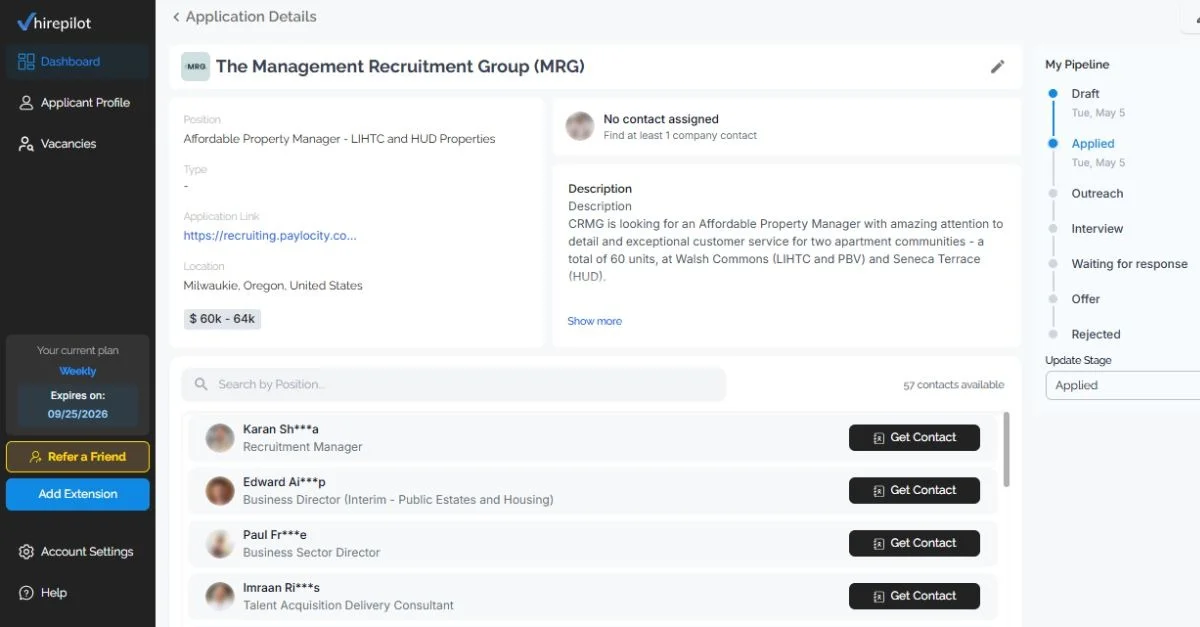
HirePilot handles both sides of that process. You autofill the application, and the tool finds the hiring manager contact so you can send a personalized message the same day without spending an hour searching LinkedIn.
FAQ: Property manager cover letter
What is a good property manager cover letter?
A strong one is specific, results-focused, and written for the type of property the employer operates. It includes the unit count of communities you have managed, at least one measurable outcome, and a direct connection to the employer's stated priorities. One page, four to five paragraphs.
How long should a property manager cover letter be?
One page. Aim for 350 to 450 words. Regional managers and owners reviewing applications are evaluating your ability to communicate efficiently and prioritize what matters. A letter that runs long works against you.
Should I mention CPM or CAM certification in a cover letter?
Yes. CPM is the most recognized credential in property management and worth one sentence in any senior role application. CAM is widely recognized in multi-family and worth mentioning for community-level positions. HCCP or similar credentials are particularly valuable for affordable housing roles and should be mentioned if you have them.
What is the best way to open a property manager cover letter?
Start with the role, the community name if possible, and one specific connection to the property type or the company's portfolio. Avoid "I am writing to express my interest." Lead with something that shows you understand what this particular property needs right now.
Do property managers still need cover letters?
For most community-level and regional roles, yes. Many property management companies use applicant tracking systems that screen on keywords before a human reviews the file. A well-written cover letter that uses the right terminology, includes unit counts, and references the correct software not only signals fit, it helps your application get through the initial filter.
Find your next job faster - without the chaos
Spend minutes, not hours, on applications. Stay organized, follow up confidently, and get noticed sooner.
Share this article

Viktor Shumylo
Viktor Shumylo is the co-founder of HirePilot, an AI-powered job search platform. He has 10+ years of experience building SaaS products and tools that help job seekers optimize resumes, streamline applications, and land interviews faster.
More articles by Viktor Shumylo