



If you're asking "how do I find a recruiter," the fastest route is to start with a job you've applied to and find the recruiter who owns it, then widen your search on LinkedIn and with staffing agencies in your field. Knowing how to find a recruiter who actually calls back comes down to one thing. Target people who are working on searches that match your title, level and location right now.
A list of "top recruiters" won't help much if none of them place people like you. Below you'll find the main types of recruiters, seven places to look for them, a way to track down the recruiter behind a specific posting, what to check before you share your resume and what to send first.
Which type of recruiter do you need?
Recruiters are paid by employers, not by you. A recruiter can only help when they have an open search that fits your background, so the first step is picking the type that fills roles like yours.
The U.S. Bureau of Labor Statistics counts recruiters in its human resources specialists group, which held about 939,700 jobs in 2025, according to the BLS Occupational Outlook Handbook. So how do you find a recruiter who fits among that many? Start with the type.
| Type | Who they work for | Best for | Where to reach them |
|---|---|---|---|
| In-house (corporate) recruiter | One employer | Getting hired at a specific company | Company LinkedIn page, careers site, job postings |
| Agency recruiter (contingency) | A staffing firm with many client employers | Mid-level, contract and temp roles at several employers | Staffing firm websites, LinkedIn, job boards |
| Retained executive search | A search firm hired for one senior role | Director, VP and C-suite roles, often confidential | Firm directories, warm introductions |
| Specialist boutique | A small firm focused on one industry or function | Niche fields like nursing, legal, IT or finance | Industry associations, conferences, peers |
Contingency means the firm earns its fee only if a candidate it presented gets hired. Retained means the employer pays the firm up front to run the search. Early and mid-career candidates will work mostly with in-house and agency recruiters.
Where to find recruiters: 7 places to look
The best places to find recruiters are LinkedIn, company pages, job postings, staffing agencies, industry events, referrals and targeted Google searches. If you're working out how to find recruiters for jobs in your field, start with the sources closest to the roles you want and work outward.
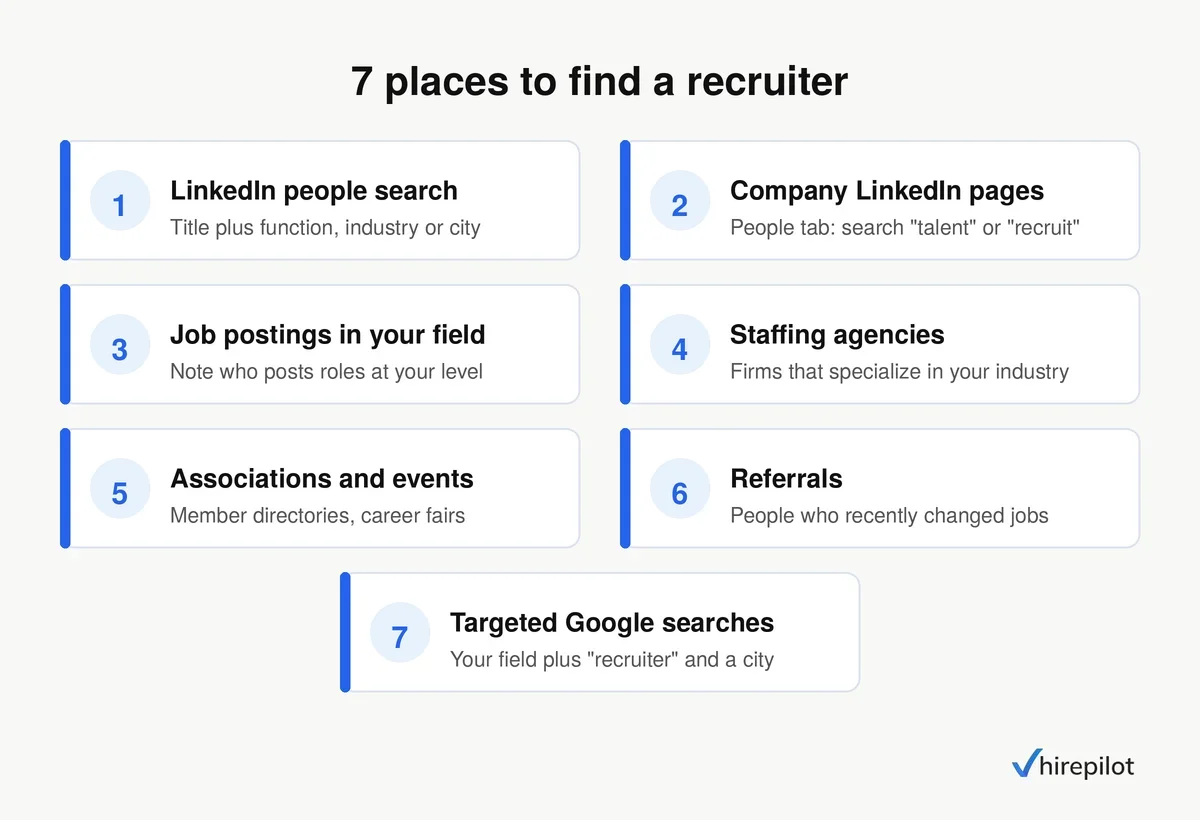
LinkedIn people search
Most recruiters keep an active LinkedIn profile, but typing "recruiter" alone returns thousands of irrelevant profiles. Combine a recruiter title with your function, industry or city, then filter by location and 2nd-degree connections so a mutual contact can introduce you.
You can also run a blank search, open People, then All filters, and set Industry to Staffing and Recruiting plus your target location. To spot recruiters hiring right now, search posts for "hiring" AND your job title.
| If you're looking for | Try this search |
|---|---|
| Marketing recruiters in Chicago | "marketing recruiter" AND Chicago |
| Healthcare recruiters for nurses | (recruiter OR "talent acquisition") AND (nurse OR nursing) |
| Recruiters for entry-level tech roles | "technical recruiter" AND ("entry level" OR "new grad") |
| Recruiters for remote finance roles | recruiter AND (finance OR accounting) AND remote |
LinkedIn search supports AND, OR, NOT, quotation marks and parentheses. Results vary with your account type and network size.
Company LinkedIn pages and careers sites
If you have a list of target companies, go straight to their talent teams. Open the company page on LinkedIn, click People and search for "talent" or "recruit." Look for titles like Talent Acquisition Partner, Technical Recruiter or Recruiting Manager.
Large companies often split recruiters by function or region, so pick the one who covers your area. Some careers sites also list the recruiting team under About, Careers or Contact.
Job postings in your field
Job postings double as a directory of recruiters. Many listings on LinkedIn, Indeed and niche boards show who posted the role or name the staffing firm behind it. Save postings that match your level and note which recruiters and firms appear again and again. Those are the people with active clients in your space.
Staffing agencies and search firms
Agencies fill roles for many employers at once, so one good relationship can open several doors. When you're deciding how to find a recruiter for jobs in a specific field, pick firms that specialize in your industry over the biggest names.
Submit your resume through the firm's site and ask to be matched with the recruiter who covers your function. Check the firm's job board too. If most listings are far from your field, keep looking.
Professional associations, career fairs and events
Recruiters who specialize in a field show up where that field gathers. Check your professional association's member directory, sponsor lists at industry conferences and recruiter booths at career fairs.
Students and recent grads can use their university's career services office, which often works directly with recruiters who hire from the school. A recruiter you've met in person is more likely to remember your name than one who got a cold resume.
Referrals from people who recently changed jobs
Ask friends, former coworkers and managers in your field who switched jobs in the past year a simple question: did a recruiter place you, and would you recommend them? An introduction from someone the recruiter already placed tells them you come from the right talent pool.
Targeted Google searches
Search your function or industry plus "recruiter," "search firm" or "staffing agency," and add a city if location matters. For example, "medical device recruiter Boston" or "legal staffing agency Washington DC." Then check each firm's team page and recent placements. Firms that publish placements at your level are worth contacting. Outside LinkedIn, this is the simplest answer to where to find a recruiter in a niche field.
How to find the recruiter for a specific job
To find the recruiter for a specific job, check the posting for a named poster first, then search the company's LinkedIn People tab for recruiters who cover that function and region. Applying through the portal and then messaging the right person is one of the most reliable ways to get a human to read your application.
It is also the best place to start looking for a recruiter at all. An agency recruiter you cold-message has no reason to reply unless one of their client roles happens to fit you. A recruiter who owns a live posting you just applied to can pull up your application in seconds and has a role to fill. Start with the job, then find the person behind it, and your message reads as a follow-up instead of a request for help.
"The contacts who answer our users are rarely the agency recruiters they cold-messaged. They are the recruiter behind a role the person applied to that same week. A specific job gives the recruiter a reason to reply." Viktor Shumylo, co-founder, HirePilot
- Check the posting. Many LinkedIn listings show who posted the job or include a "Meet the hiring team" section.
- Search the People tab. Filter by "talent" or "recruit," then by location. A recruiter based in the same region as the role is the likeliest owner.
- Search posts for the job title. Search the exact title plus the company name and filter by Posts. Recruiters often share their own openings.
- Look for "our client." If the posting hides the company name, a staffing or search firm is running it. Find that firm's recruiter for your function instead.
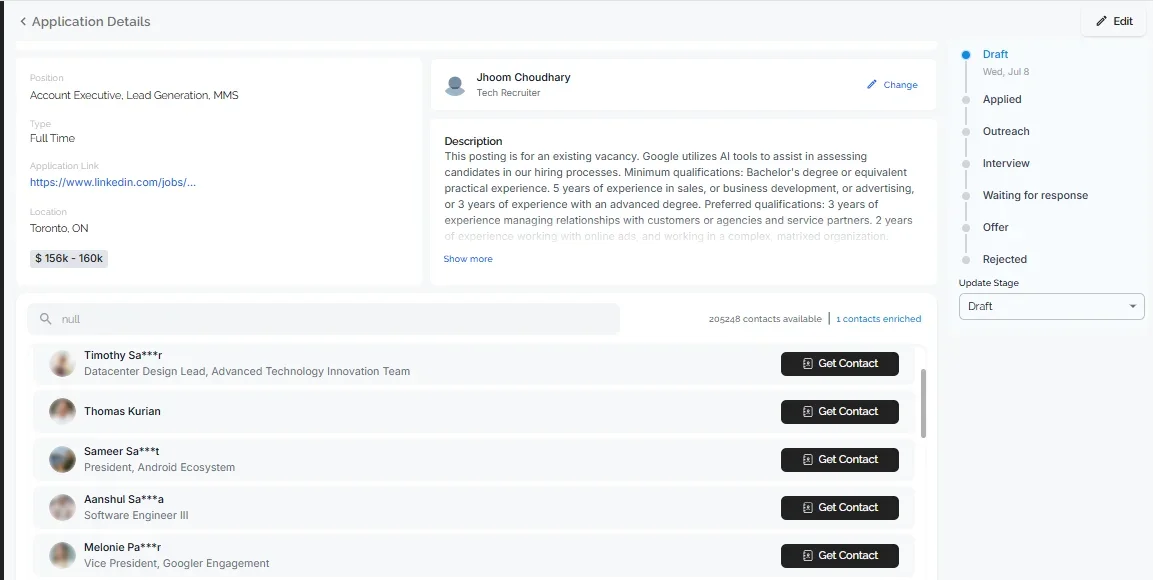
If the trail goes cold, the hiring manager is often a better contact anyway, and the same LinkedIn research helps you find the hiring manager for a job posting. HirePilot's Recruiter Outreach skips the manual search: it finds contacts at the company you're applying to, including the recruiters and hiring managers behind the role, and suggests a short, personalized message for LinkedIn or email.
How to find a good recruiter before you share your resume
A good recruiter specializes in your field, is working on roles like yours right now and asks before sending your resume anywhere. Knowing how to find good recruiters matters because the wrong one can waste weeks or submit you to employers you'd rather approach yourself.
- Specialization. Their recent posts and placements match your function and level, not just your general industry.
- Active searches. They've shared open roles in your field in the past few weeks.
- Track record. Their LinkedIn profile has recommendations from candidates and hiring managers.
- Stability. They've stayed with the same firm for a while instead of switching every few months.
- Permission first. They tell you which employer they want to submit you to and wait for your OK.
Red flags to watch for
Walk away if a recruiter sends your resume without asking, can't name a single client, pushes you toward roles far from your goals or asks you for money. Any of these suggests the recruiter cares more about volume than about placing you well.
Questions to ask on the first call
- What roles and levels do you place most often?
- Is this search on contingency or retained?
- Which of your clients fit my background right now?
- Will you always check with me before submitting my resume?
- How often will you update me, and what happens if an employer passes?
- Have you recently placed someone with a background like mine?
How to reach out so a recruiter replies
A recruiter replies when your first message reads like a candidate they could present tomorrow. If there's an open role, apply first, then message the recruiter and name the job title and job ID so they can find your application.
Keep it under 100 words: your current title, the role and level you want, your location or remote preference and one result that proves you fit.
Example: Hi Jordan, I applied for the Senior Marketing Manager role (job ID 48213) at Acme today. I'm a marketing manager with six years in B2B SaaS, and in my current role I doubled inbound demo requests in a year. I'm looking for senior marketing roles in Chicago or remote. Would you be open to a 15-minute call next week?
If you don't hear back, follow up once after about a week, then move on. For more templates, see what to write when you message a recruiter on LinkedIn. If your messages keep going unanswered, it helps to know why recruiters don't respond to messages and what to change.
How to work with several recruiters without double submissions
Two to four recruiters at a time is a practical range: enough to cover different firms, few enough to keep track of. Agency recruiters often share clients, and if two of them submit you to the same employer, the company may drop you rather than decide which firm earns the fee.
Keep a simple log of who submitted you, to which company and when, and tell each recruiter where you've already applied. Be honest about other interviews and offers too, since recruiters can move faster when they know you're close to one.
HirePilot's Job Tracker keeps every application on a Kanban board with stages, notes and contact statuses that you update yourself, so you can see at a glance which recruiter is handling which role.
Make it easy for recruiters to find you
Recruiters search for candidates as much as you search for them. Put the job title you want in your LinkedIn headline, add skills and keywords from postings you're targeting and turn on Open to Work, which you can show to recruiters only. Keep an updated resume on the job boards you use, so recruiters searching their databases can find you between your own outreach.
FAQ
How much does it cost to get a recruiter?
Nothing. Recruiters who fill roles are paid by the employer, so job seekers don't pay to work with them. Paid candidate-side services such as career coaching or reverse recruiting exist, but they are a separate service and should say so up front.
What is the best way to find a recruiter?
Start with a job you've applied to and find the recruiter who owns it on the company's LinkedIn People tab. That recruiter already has a role to fill, so a short message is more likely to get a reply than cold outreach to agency recruiters.
Is a headhunter the same as a recruiter?
A headhunter is a type of recruiter, usually in executive search, who fills senior roles and often approaches people who aren't job hunting. Every headhunter is a recruiter, but most recruiters aren't headhunters.
Where can I find a recruiter near me?
Search Google for your field plus "recruiter" and your city, check local offices of staffing agencies and use LinkedIn's location filter on recruiter searches. Local career fairs are another good option.
Can a recruiter help if I'm entry level?
Yes, mainly staffing agencies that fill high-volume or contract roles and campus recruiters who hire through university career services. Executive search firms rarely work with entry-level candidates.
What if no recruiter responds to me?
Silence usually means the recruiter has no current search that fits you. Follow up once after a week, then shift your list toward recruiters who specialize more closely in your function and level.
Where to start
Knowing how to find a recruiter comes down to targeting people who fill roles like yours right now: start with the recruiter behind a job you've applied to, use the seven places above to widen your list, vet recruiters before you share your resume and keep your first message short. Recruiters only work on roles their clients have open, so keep applying directly and reach the hiring manager when a recruiter goes quiet.
HirePilot brings that work into one place with a Job Board, autofill for applications, a Job Tracker and Recruiter Outreach that finds contacts at the companies you apply to. Start for free and send your first outreach today.
Find your next job faster - without the chaos
Spend minutes, not hours, on applications. Stay organized, follow up confidently, and get noticed sooner.
Share this article

Viktor Shumylo
Viktor Shumylo is the co-founder of HirePilot, an AI-powered job search platform. He has 10+ years of experience building SaaS products and tools that help job seekers optimize resumes, streamline applications, and land interviews faster.
More articles by Viktor Shumylo