



Your phone buzzes. You glance down and see a number you don't recognize. You let it ring, then check the voicemail. It's a recruiter from a company you applied to three weeks ago. They want to schedule a quick call, and they're available tomorrow morning. Your stomach drops. You haven't looked at that job description since you hit submit. You don't remember what you wrote in your cover letter, and you have no idea what to say when they ask why you want this role.
That moment of panic is more common than most people admit. The phone screen catches candidates off guard because it arrives without ceremony. There's no conference room, no suit, no ritual to signal that you're stepping into interview mode. It's just you, a phone, and a recruiter who will decide in 20 minutes whether you move forward or get a polite rejection email.
The good news is that a phone interview is entirely survivable, and with the right structure, it becomes an advantage. This guide covers every practical angle: how to prepare before the call, what to say during it, which questions to expect, how to handle the ones that trip people up, and what separates candidates who advance from candidates who get screened out.
What a phone screen actually is (and why it matters)
A phone screen is not a casual get-to-know-you conversation. It is a filter. The recruiter's job is to eliminate candidates who are not a fit before investing the company's time in a full interview. They're checking for basic qualifications, communication ability, compensation alignment, and cultural signals, all in under half an hour.
Most candidates treat the phone screen like a warm-up round. They wing it, speak in vague generalities, and assume their resume will carry the conversation. Then they wonder why they never hear back. The phone screen is where a disproportionate number of qualified candidates lose opportunities they were genuinely right for.
Understanding that reality changes how you prepare. You don't need to be perfect. You need to be structured, specific, and ready.
Preparing for a phone job interview: the 24-hour checklist
Preparation doesn't require days of study. Most of what you need can be done in one focused session the night before or the morning of the call.
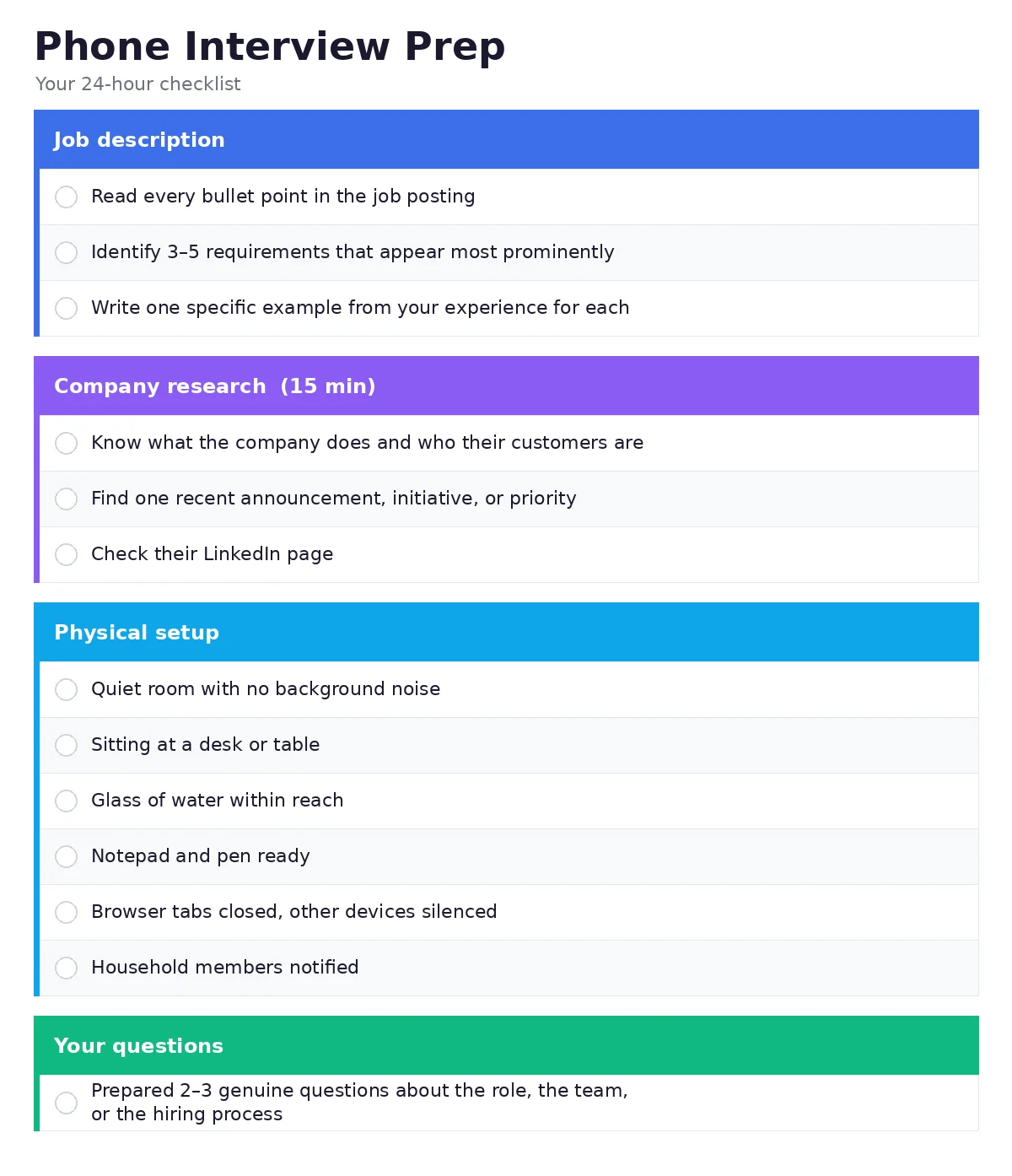
Review the job description line by line
Pull up the job posting and read every bullet point. Identify the three to five requirements that appear most prominently. These are the areas the recruiter is most likely to probe. For each one, think of a specific example from your experience that demonstrates that skill.
Write those examples down in a format you can reference during the call. Seeing them on paper keeps you from drawing a blank when the pressure is on.
Research the company at a surface level
You don't need to know the company's entire history. You need to know what they do, who their customers are, and one or two recent things they've announced or prioritized. Spend 15 minutes on their website, their LinkedIn page, and one news article. That's enough to sound informed without sounding like you memorized their press kit.
Set up your physical environment
Choose a quiet room with no background noise. Sit at a desk or table, not on your couch. Keep a glass of water nearby because nerves dry out your throat. Have a notepad and pen ready so you can jot down the recruiter's name, any key details they share, and questions that come up during the call.
Close your browser tabs, silence your other devices, and put a note on your door if you share a space with other people. The call itself lasts 20 to 30 minutes. Protecting that window from interruptions costs nothing and signals professionalism.
Prepare your own questions
Recruiter calls end with your chance to ask questions. Candidates who say "I think you covered everything" leave a weak impression. Prepare two or three genuine questions about the role, the team, or the hiring process. Knowing the right questions to ask in a job interview makes a measurable difference in how the recruiter perceives your interest level.
What to expect during the call
Most phone screens follow a predictable structure. Knowing the sequence helps you stay calm when you're in it.
The recruiter will open with a brief introduction about themselves and the company. Then they'll ask you to walk them through your background. From there, they'll ask a mix of experience questions, situational questions, and a few logistical questions about your availability, compensation expectations, and whether you're interviewing elsewhere. At the end, they'll invite you to ask questions, then explain the next steps.
The whole conversation usually runs 20 to 30 minutes. If it runs shorter, that's often a signal the recruiter moved on quickly. If it runs longer, that's usually a good sign.
How to structure your answers: the method that actually works
The biggest mistake candidates make on phone screens is answering in streams of consciousness. They start talking, drift through their history, and leave the recruiter trying to extract a coherent point. Structured answers are more compelling, easier to follow, and shorter, which respects the recruiter's time.
Use the STAR method for behavioral questions
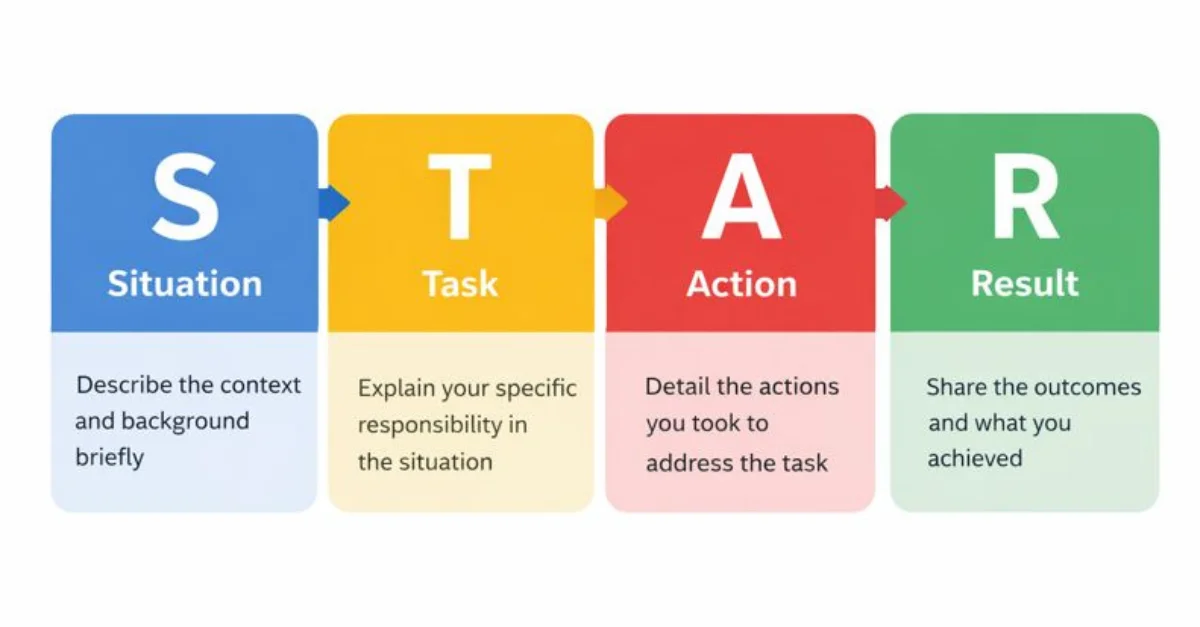
STAR stands for Situation, Task, Action, Result. It gives every answer a beginning, middle, and end.
Situation: briefly describe the context. Task: explain what you were responsible for. Action: describe what you specifically did. Result: share what happened because of your actions. Keep each section short. The whole answer should take 60 to 90 seconds. Anything longer and you're losing the recruiter.
Use the "headline first" approach for general questions
When someone asks "tell me about yourself," they don't want your full career history. Lead with a one-sentence summary of who you are professionally, follow with two or three relevant achievements, and close with why you're interested in this opportunity. That structure takes 60 to 75 seconds and leaves a sharper impression than a three-minute biography.
Be specific, not general
Recruiters hear vague answers hundreds of times a week. "I'm a strong communicator" means nothing. "I led weekly syncs across three time zones for a team of 12 and reduced project delays by 20 percent" is a real data point. Whenever possible, attach a number, a timeframe, or a concrete outcome to your examples.
Sample questions and answers for a phone interview
These questions come up in almost every phone screen regardless of industry. Practicing your answers out loud before the call makes a significant difference in how natural you sound during it.
"Tell me about yourself."
Strong answer structure: "I'm a [job title or professional identity] with [X] years of experience in [field or function]. Most recently, I [specific accomplishment relevant to this role]. I'm looking for my next opportunity because [genuine reason], and this role stood out to me because [specific element of the job or company]."
What to avoid: starting with "Well, I was born in..." or listing every job you've ever had.
"Why are you interested in this role?"
Strong answer structure: Connect one or two things from the job description to something specific in your background or professional goals. Show that you read the posting carefully. Show that you understand what the company does.
What to avoid: "It seems like a great opportunity" or anything that could apply to any job at any company.
"What are your salary expectations?"
This question trips many candidates because they either undersell themselves or quote a number that takes them out of range before the conversation has started. Research the market range before the call. Give a range rather than a single number, and anchor the bottom of your range where you'd actually be satisfied. Then invite a conversation: "That range is based on what I've seen for this type of role in this market. I'm open to discussing the full compensation picture."
"What's your biggest weakness?"
The recruiter isn't looking for a real confession. They're looking for self-awareness and evidence that you work on your gaps. Choose something genuine but not disqualifying. Describe what you've actively done to address it. Keep the answer brief.
"Are you interviewing elsewhere?"
Be honest but strategic. If you are, you can say so without naming specific companies. "I'm actively exploring a few opportunities in this space. This one is a strong match because [reason]." That answer signals that you're in demand and that you've thought specifically about this role.
"The candidates we see advance through phone screens are almost never the most polished. They're the ones who answer the actual question being asked. Specificity is the differentiator, not charisma, not years of experience, not the perfect resume." Viktor Shumylo, co-founder, HirePilot
Telephone job interview tips for specific situations

First job interview tips for early-career candidates
If you're interviewing for your first professional role, the absence of work history doesn't have to be a liability. Draw from internships, class projects, volunteer work, part-time jobs, and any context where you demonstrated relevant skills. Use the same STAR structure. The recruiter is evaluating your communication, your curiosity, and your potential, not just your resume depth.
For first-job seekers, preparation matters even more because you have less experience to fall back on. Knowing your story cold and sounding organized on the phone will set you apart from peers who haven't put in the same effort. A guide on how to prepare for a job interview in 12 steps covers additional preparation strategies that apply at every career level.
Education job interview questions and answers
Interviews for roles in education, whether teaching positions, administrative roles, or instructional design, tend to include questions about classroom management, student outcomes, curriculum development, and collaboration with parents or colleagues. Common phone screen questions for education roles include:
"Describe a time you adapted your approach for a struggling student." "How do you handle conflict with a parent or guardian?" "What does differentiated instruction look like in your practice?"
Use STAR for each. Ground your answers in specific classrooms, grade levels, or student populations. Avoid abstract philosophy. Concrete examples carry more weight in education interviews than theoretical frameworks.
Preparing for a phone job interview when you're currently employed
When you're in a job and fielding calls during work hours, logistics become a real issue. Set up a dedicated time slot for recruiter calls so you're not taking them in a bathroom stall or whispering at your desk. If a recruiter calls unexpectedly and you can't speak freely, it's completely acceptable to say, "I'm so glad you reached out. I'm not able to speak at this moment. Can we schedule a call for [specific time]?" That response is professional, it signals interest, and it puts you in a better position than whispering through a seven-minute call with one ear on the door.
What to avoid saying on a phone screen
Some responses are more damaging than a blank answer. Avoid these patterns:
Speaking negatively about a current or former employer. Recruiters hear this as a risk signal, not sympathy. Giving rambling non-answers when you don't know something. A structured "I haven't encountered that specific situation, but here's how I'd approach it" is far stronger than 45 seconds of padding. Using filler phrases like "you know," "kind of," and "sort of" excessively. They undermine your credibility on a phone call where your voice is the only signal the recruiter has to work with.
Why qualified candidates fail phone screens
Here is the non-obvious truth about phone screens. Most candidates who fail them are not unqualified. They lose not because they lack the experience but because they had no structure for their answers.
A recruiter conducting 15 phone screens in a week is listening for clarity and specificity. A candidate who says "I have a lot of experience managing teams" sounds the same as every other candidate who said the same thing that morning. A candidate who says "I managed a team of eight engineers across two product lines, and I'll give you a specific example of how I handled underperformance" immediately stands out. The content may be similar. The delivery is entirely different.
Structure is not about sounding rehearsed. It's about respecting the recruiter's time and giving them something concrete to write down. Recruiters take notes. What they write down after your call determines whether they recommend you to the hiring manager. Give them material worth writing.
After the call: what to do in the next hour
Send a brief thank-you email within 60 minutes of hanging up. Keep it to three sentences. Reference something specific from the conversation, restate your interest in the role, and confirm the next step they outlined. This email does not need to be elaborate. It needs to exist.
Candidates who send a thoughtful follow-up after a phone screen are the minority. That makes the gesture more noticeable, not less.
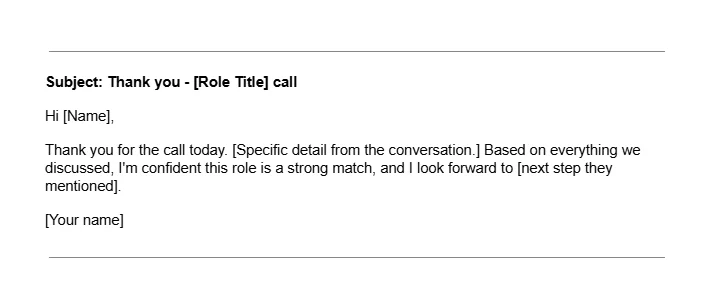
For context on how to time and structure your follow-up, a resource on following up on a job application with templates covers the mechanics in detail.
Also, update your job tracking record immediately after the call. Note the recruiter's name, the questions they asked, the topics they emphasized, and the timeline they described. If you advance to the next round, this information is invaluable preparation.
A phone screen is a filter, not a conversation
Here is the non-obvious truth that most candidates never hear: a phone screen is not a casual chat. It is a filter round, and most candidates lose it not because of qualifications but because they had no structure for their answers.
Recruiters are not hoping you'll fail. They're hoping you'll give them a reason to move you forward. But they're also pressed for time, and they're comparing you against other candidates who may have tighter, cleaner answers even if they have less experience.
Structure is what separates a "maybe" from a "yes." Not charisma, not perfect credentials. When a recruiter can follow your answer from beginning to middle to a clear result, they trust you. When they can't follow you, they hesitate. And in a filter round, hesitation becomes a "no."
The practical implication is that you should never walk into a phone screen without having spoken your key STAR answers out loud at least twice. Not thought through them. Spoken them. The difference between practiced and unpracticed answers is audible to anyone who interviews candidates regularly.
Bureau of Labor Statistics data on interview preparation practices shows that human resources specialists and recruiters spend a significant portion of their work evaluating candidate communication skills, which reinforces why answer structure matters as much as content.
Research from SHRM on structured interviewing techniques consistently finds that structured interview formats produce more reliable hiring outcomes, which is why more recruiters are trained to evaluate how candidates organize their responses, not just what they say.
"We see users apply to dozens of jobs and then get a call from one of those companies three weeks later with no memory of why they applied. That gap between application and call is where preparation breaks down. The phone screen gets lost because there was no system behind the search." Viktor Shumylo, co-founder, HirePilot
Getting to the phone screen in the first place
None of this matters if your application isn't surfacing. Recruiters can only call you if they've seen your materials. The gap between submitting an application and getting a call is where many job seekers lose momentum.
HirePilot addresses both sides of that gap. The Autofill feature fills out application forms automatically on LinkedIn Easy Apply, Indeed, and Workday, including the screening questions that slow most people down. The Job Tracker captures every application in a Kanban board the moment you autofill it, so you always know where each opportunity stands. And when you want to move past the application queue entirely, the Recruiter Outreach feature helps you identify the hiring manager and send a personalized AI-written message the same day you apply. That combination, covering the form and the follow-through, is what turns a job search from passive waiting into active movement.
You prepared for the call. You structured your answers. You sent the follow-up. The next step is making sure enough applications are reaching the right people in the first place. HirePilot is built to help you get there faster and stay organized while you do.
FAQ
What are the best phone job interview tips for someone who gets nervous?
Preparation is the most reliable anxiety reducer. Practice your answers out loud before the call, not just in your head. Standing or sitting up straight during the call affects your vocal confidence more than most people expect. Keep a glass of water nearby, breathe before you answer each question, and remember that a 2-second pause before responding sounds more thoughtful than rambling immediately.
What is preparing for a phone job interview actually supposed to look like?
Solid preparation includes reviewing the job description and identifying three to five key requirements, researching the company at a surface level, writing out your STAR-format examples for likely questions, setting up a quiet space for the call, and preparing two or three questions to ask at the end. This takes one to two hours if you're focused. The candidates who skip it are obvious to recruiters within the first five minutes.
What are common education job interview questions and answers for a phone screen?
Education phone screens typically include questions about classroom management strategies, how you approach differentiated learning, a time you navigated a difficult parent or guardian interaction, and how you measure student progress. Answer each with a specific example drawn from a real classroom or educational setting. Avoid speaking only in educational theory. Hiring managers in education want evidence of practical application.
What should I say when asked about salary expectations on a phone screen?
Research the market range for the role before the call using sources like salary surveys or industry benchmarks. Give a range rather than a single number, and anchor the floor of that range where you'd genuinely be satisfied. Frame it as a starting point for a broader conversation about the total compensation package, including benefits, flexibility, and growth potential.
What are first job interview tips for someone with no professional experience?
Draw from internships, class projects, volunteer roles, part-time jobs, and any structured activity where you demonstrated relevant skills. Use the STAR format to give your examples structure even if the context is academic. Recruiters interviewing entry-level candidates are evaluating curiosity, communication, and potential. Sounding organized and self-aware carries significant weight when your resume is light on titles.
Find your next job faster - without the chaos
Spend minutes, not hours, on applications. Stay organized, follow up confidently, and get noticed sooner.
Share this article

Viktor Shumylo
Viktor Shumylo is the co-founder of HirePilot, an AI-powered job search platform. He has 10+ years of experience building SaaS products and tools that help job seekers optimize resumes, streamline applications, and land interviews faster.
More articles by Viktor Shumylo