


You hit submit. The confirmation page loaded. Maybe you got a generic "thanks for applying" email. And then nothing. No call, no email, no status update. Just silence.
Most job seekers should expect to wait one to three weeks before hearing back from a company, longer at larger organizations with multiple interview stages. That waiting period for a response is separate from when you should act: send your first follow-up three to five business days after applying, then a second one around day 10 to 12 if you still hear nothing.
That silence is one of the most disorienting parts of a modern job search. You put real effort into tailoring a resume, writing a cover letter, navigating a clunky applicant portal, and the reward is a void. You do not know if a human being has seen your application. You do not know if the role is already filled. You do not know whether to wait another week or just move on.
The uncertainty pushes people toward two extremes: refreshing their email every few hours for weeks, or assuming rejection after a few days and never following up at all. Both responses cost you opportunities. What you need is a concrete answer and a clear system.
Why three to five days, and not longer
The window is not arbitrary. Recruiters at most companies begin reviewing applications within a few days of posting or receiving them, especially for roles with active hiring urgency. Wait much longer than five days and you risk following up after the recruiter has already moved the first batch of candidates to the phone screen stage. You also risk looking passive or disengaged.
If you applied through a job board like Indeed or LinkedIn and the role is still posted, the recruiter is almost certainly still reviewing applications. A brief, professional follow-up at the three to five day mark puts your name back in front of them at the exact moment decisions are being made.
What the silence actually means (and what it does not)
Silence after applying is not the same as rejection. Companies receive hundreds of applications per open role, and most recruiters are managing five to fifteen open requisitions simultaneously. The absence of a response in the first few days almost never signals that you were rejected. It usually means your application is sitting in a queue.
There are a few signals worth paying attention to in those early days.
No auto-reply after applying
If you submitted your application and received zero confirmation, that is worth noting. Some older applicant tracking systems do not send automatic acknowledgments. But if the company is using a modern system like Workday or Greenhouse, a confirmation email is standard. No auto-reply may mean your application did not submit correctly, or it landed in spam. Log the date and follow up within three days asking to confirm receipt.
Application status stuck on "submitted" or "under review"
Most ATS portals show a status field that updates as candidates move through stages. If your status has not moved in five to seven business days, that is normal. If it has not moved in three to four weeks, the role may have been paused, filled internally, or deprioritized. That is a reasonable point to either send a second follow-up or redirect your energy elsewhere.
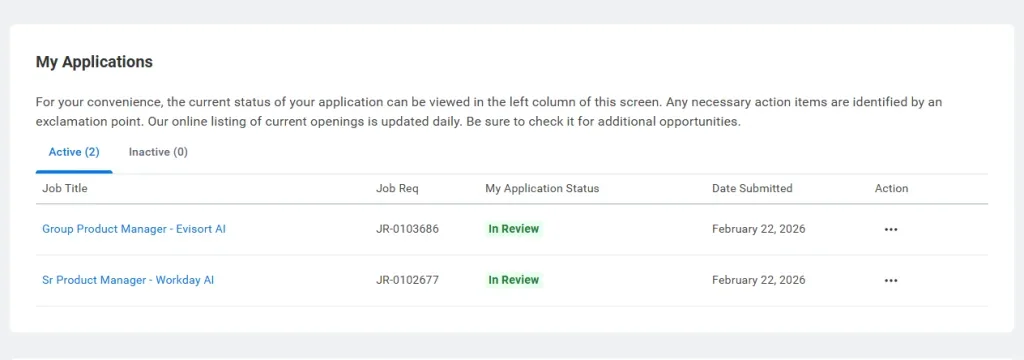
Most of that silence comes down to volume rather than rejection. Applicant tracking systems are built specifically to filter and rank large numbers of resumes before a human ever sees them, which is why your application can sit untouched for days without meaning anything about your chances.
No recruiter view on LinkedIn
If you applied through LinkedIn and can see that no one from the company has viewed your profile, that does not mean your application was ignored. Recruiters often work inside their ATS rather than on LinkedIn directly. Do not read too much into LinkedIn profile view data as a signal of application progress.
Why most people follow up too late
The conventional advice has long been to wait one to two weeks before following up. That advice made sense in an era when paper applications arrived by mail and hiring moved slowly. It does not reflect how most companies hire now.
Many hiring decisions move fast, especially for roles where the team is understaffed. A recruiter might schedule phone screens within three to five days of a posting going live. If you are waiting two weeks to follow up, you may be reaching out after the recruiter has already moved five candidates forward.
There is also a psychological component. The longer you wait, the more uncertain and apologetic your follow-up tends to sound. A follow-up sent three days after applying feels natural and professional. A follow-up sent three weeks after applying often reads as an afterthought.
If you are not sure what to say in that first follow-up email, follow-up email templates after applying can give you a starting point that does not come across as desperate or aggressive.
The hidden cost of not tracking your submission dates
Here is where most job seekers lose ground. They apply to a role, do not write down the exact date, and then have no idea when the three-to-five-day window has passed. They either forget to follow up entirely or send a vague message weeks later with no clear frame of reference.
This problem compounds when you are applying to multiple roles at once. Keeping track of twenty or thirty active applications in your head is not realistic. Most people end up with a rough mental map of where they applied, no memory of exact dates, and no system for knowing when each follow-up is due.
That mental overhead is exhausting, and it costs you real opportunities.
How HirePilot's tracker removes the guesswork
HirePilot's Autofill and Job Tracker work together to solve this problem directly. When you use HirePilot's autofill to submit an application on LinkedIn, Indeed, or Workday, the tracker automatically saves the application with the exact submission date. You do not have to log anything manually. The date is already captured.
From there, that date sits directly on the application card in your Kanban board, so instead of guessing whether it has been three days or ten, you can see it at a glance and decide your next move. No refreshing your email. No trying to remember which day you applied. The record is already there when you need it.
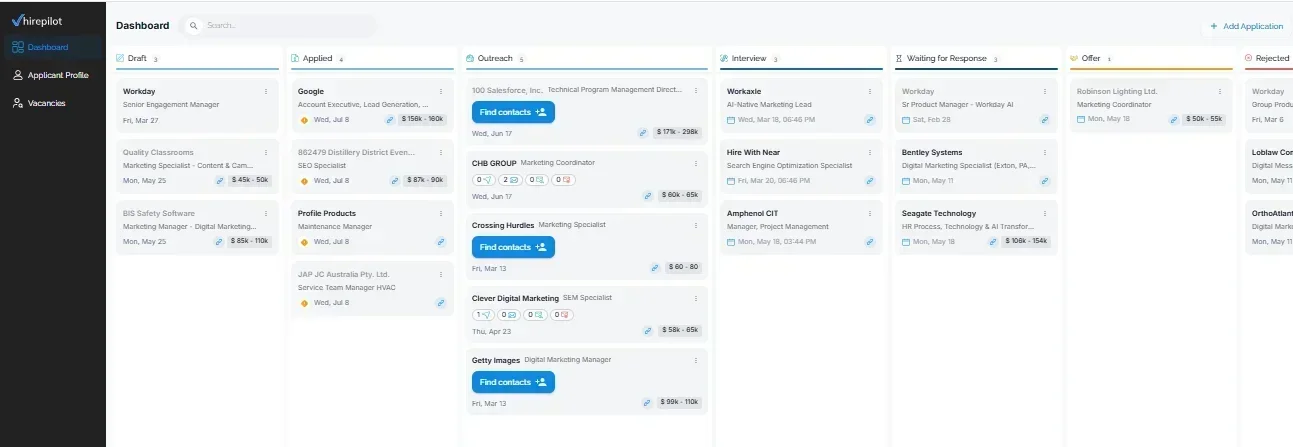
This matters most when you are applying consistently at high volume. If you are submitting ten to twenty or more applications per week, having a kanban-style board that shows each application's status, submission date, and next action makes the difference between a structured job search and a chaotic one. Using a job application tracker effectively is one of the clearest ways to stop losing track of good opportunities.
When to send a second follow-up
If you sent your first follow-up at the three-to-five-day mark and received no response, wait another five to seven business days before sending a second message. Keep it short. Acknowledge that they may be busy, restate your interest, and offer to provide anything else they need.
Two follow-ups is generally the limit. If you have sent two professional messages after the initial application and heard nothing back, you can reasonably deprioritize the role and focus your energy on applications where there is active movement.
That said, do not delete the record from your tracker. Roles get unfrozen. Candidates fall through. A recruiter may circle back weeks later, and when they do, having your submission date and follow-up history documented helps you respond quickly and confidently.
Contacting the hiring manager directly
If you can find the hiring manager's name and contact information, a direct outreach message sent around the same time as your application follow-up can significantly increase your visibility. Most applicants never do this. The ones who do tend to get responses at a much higher rate.
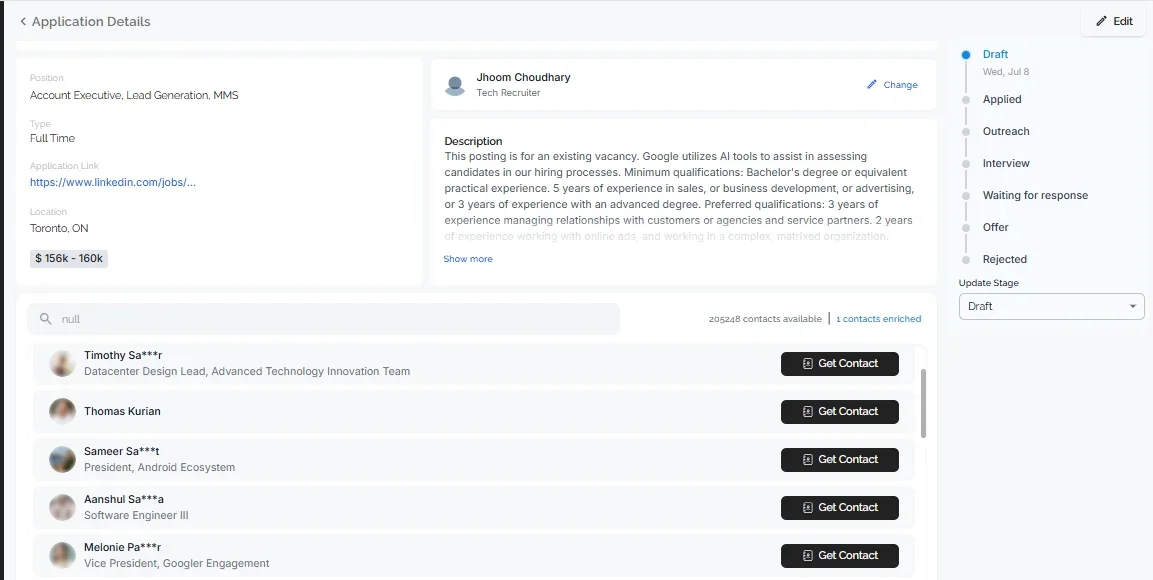
This is what HirePilot's Recruiter Outreach feature is built for. It helps you identify the right hiring manager and send a personalized, AI-drafted message the same day you apply. Instead of waiting to see whether your application floats to the top of a pile, you create a second point of contact that bypasses the queue entirely. Combined with a well-timed follow-up email, this approach addresses the two main reasons qualified candidates get ignored: the application never got seen, and no one had a reason to pull it out of the stack.
Reading the room: when to move on
There are clear signals that a role is no longer worth pursuing actively. If the job posting has been removed, you have sent two follow-ups with no response, and the role has been reposted under a slightly different title, the company is likely resetting their search or the position requirements changed. You can leave the application in your tracker as a reference point and move on.
If the company posts a similar role weeks after you applied, there is nothing wrong with applying to the new posting and noting in your follow-up that you had previously expressed interest. This resets your application into an active review cycle.
The broader principle is that your energy should track with the signal strength from each company. Active responses get your attention. Persistent silence gets deprioritized, not chased.
Signature insight: the three-to-five-day rule works because of recruiter workflow, not politeness
Most advice about when to follow up is framed around etiquette. Do not seem pushy. Give them time to breathe. These framings focus on optics rather than mechanics.
The real reason three to five days is the right window is that it maps to how most recruiters actually structure their review process. Many recruiters do a first-pass review of applications within the first week of a posting going live, then set up a second review before scheduling phone screens. A follow-up that arrives in that first-pass window is seen alongside your application, not as a separate nuisance. It reinforces your candidacy rather than interrupting a process that has already moved past you.
Understanding recruiter workflow, not just recruiter feelings, is what makes the timing effective. This is also why following up after one month almost never works. By that point, the recruiter's mental map of the role's candidate pool has usually solidified. You are not prompting a re-review. You are asking them to go back and reopen a decision they may have already made.
The best job seekers treat the post-submission period as part of their active strategy, not as a passive waiting room. Organizing job applications with automated personalization is how you stay in that active posture without burning hours on administrative tasks.
"Most people treat the follow-up like an afterthought, something to send if they feel brave enough. It should be part of the application itself. The candidates who follow up on day three or four are not being pushy, they are simply still visible when the recruiter is actually looking. Wait two weeks out of politeness and you have made yourself invisible on purpose." Viktor Shumylo, co-founder, HirePilot
Stop refreshing your inbox and start your follow-up with a system
The anxiety of post-application silence is real, and it does not go away by waiting longer or hoping harder. It goes away by knowing exactly what you submitted, exactly when you submitted it, and exactly when to take your next action.
If you are manually tracking applications in a spreadsheet, guessing at submission dates, or simply hoping a recruiter will email you back unprompted, you are leaving real opportunities on the table. According to SHRM research on recruiting timelines, the gap between application submission and recruiter response has grown, which makes proactive follow-up even more important for standing out.
You submitted the application. Now treat the follow-up as part of the process, not an awkward afterthought. HirePilot logs your submission dates automatically, fills your forms for you, and helps you reach a hiring contact directly, so the only thing left for you to decide is when to send the note. Start your structured search at hirepilot.co.
FAQ
How long to wait after submitting a job application online before following up?
Wait three to five business days after submitting. This window aligns with when most recruiters conduct their initial review and gives you the best chance of your follow-up being seen alongside your application rather than after decisions have already been made.
What if I never got a confirmation email after applying?
If you did not receive an auto-reply, your application may not have submitted correctly or the confirmation landed in spam. Follow up within two to three days to confirm receipt. Note the submission attempt in your tracker with the date so you have a record regardless of the outcome.
Should I follow up by email or LinkedIn message?
Email is generally more professional and more likely to reach the recruiter directly. A LinkedIn message to the hiring manager can work as a complement to an email follow-up, especially if you can personalize it around a specific aspect of the role or company. Avoid sending the same message on both channels the same day.
What does it mean when my application status says "under review" for weeks?
"Under review" typically means your application has been received but not yet advanced or rejected. If the status has not changed in three to four weeks and you have already sent a follow-up with no response, the role may be on hold or the recruiter may be prioritizing other candidates. It is reasonable to deprioritize that application and focus on more active opportunities.
How many times should you follow up on a job application?
Two follow-ups total is the general limit. The first goes out at three to five business days after applying. If there is no response, a second brief message five to seven business days after the first is appropriate. Beyond that, continued outreach rarely produces a different result and can leave a negative impression.
Find your next job faster - without the chaos
Spend minutes, not hours, on applications. Stay organized, follow up confidently, and get noticed sooner.
Share this article

Viktor Shumylo
Viktor Shumylo is the co-founder of HirePilot, an AI-powered job search platform. He has 10+ years of experience building SaaS products and tools that help job seekers optimize resumes, streamline applications, and land interviews faster.
More articles by Viktor Shumylo