


You sent 40 applications last month. You heard back from two. One was a rejection. The other was a recruiter who ghosted you after the first call. You refreshed your inbox every morning, checked your spam folder twice a day, and started wondering if something was broken with your resume, your LinkedIn, or you.
Nothing is broken with you. The job market right now is just harder to navigate than the numbers suggest, and most people are still running a strategy built for a different era.
Here is what is actually happening in the current job market, and what it means for your search.
How is the job market right now?
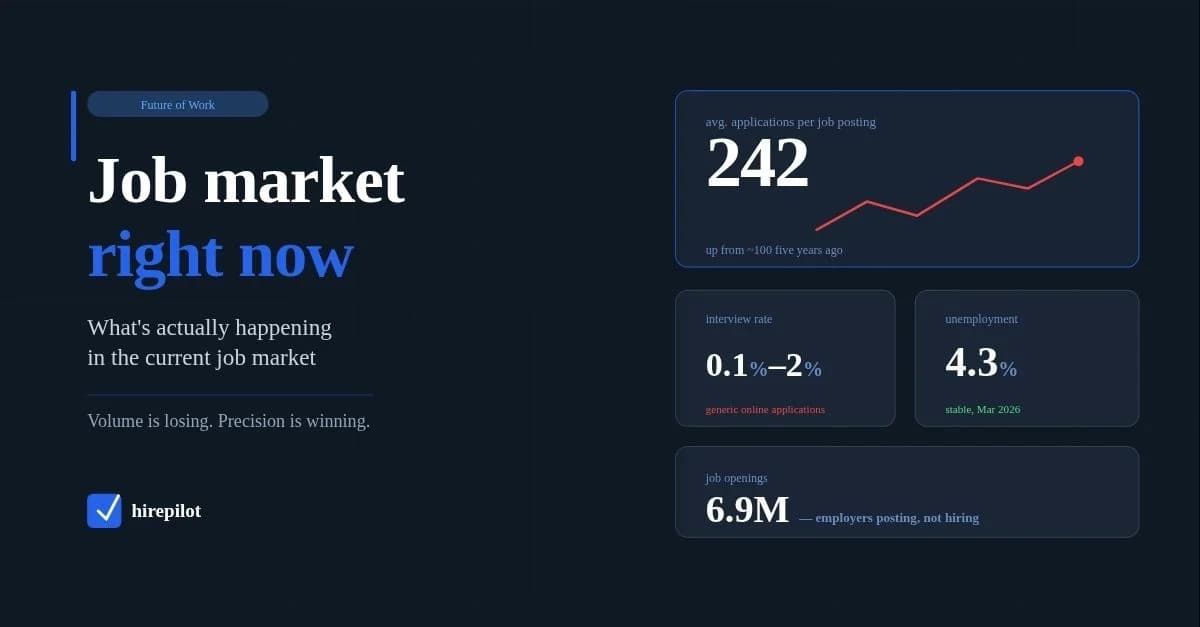
The U.S. unemployment rate sits at 4.3% as of March 2026. That is close to what economists call full employment. On paper, the current job market looks stable. Employers added 178,000 jobs in March, well above most forecasts.
But those numbers describe the macro picture. They don't describe what it feels like to be searching for work right now.
According to the Bureau of Labor Statistics February 2026 JOLTS report, job openings held at 6.9 million, but hires fell to 4.8 million, the lowest hiring rate since April 2020. Employers are posting jobs. They are just not filling them at the pace you would expect. The result is a market that looks active from a distance but feels frozen when you're inside it.
The quits rate, one of the clearest signals of worker confidence, dropped to 1.9%, among the lowest readings in years. People who have jobs are staying put. That means fewer openings created by voluntary movement. The roles that do open up attract more applicants than ever before.
Why it feels harder than the data suggests

The average job posting in 2026 receives 242 applications. Five years ago, the same posting attracted roughly 100. That number has more than doubled, driven in large part by the rise of one-click applications and AI-assisted resume tools that made it easier than ever to apply at scale.
The irony is that easier applications made the process harder for everyone. Recruiters are overwhelmed. Screening filters tightened. Many strong candidates get eliminated before a human being ever reads their application. An estimated 80% or more of resumes are filtered out by applicant tracking systems before they reach a hiring manager. If you want to understand how ATS filters actually work and what you can do about it, this guide on what ATS systems do and how to get past them breaks it down step by step.
The math works against you if you are playing a volume game. Generic applications to unfiltered job boards result in interview rates between 0.1% and 2%. That means 100 applications might produce one or two callbacks, if you are lucky. Long-term unemployment is rising. The number of people jobless for 27 weeks or more climbed to 1.8 million in March, up over 300,000 compared to a year earlier.
This is the job market right now: stable on the surface, highly competitive underneath.
The industries that are actually hiring
Not every sector is frozen. Understanding where hiring is active is one of the most practical things you can do right now.
Health care is the clearest bright spot. The sector added 76,000 jobs in March alone, and has averaged about 29,000 new positions per month over the past year. Construction added 26,000 jobs in March. Transportation and warehousing picked up 21,000. Social assistance has also continued to grow.
Technology hiring is uneven. Some roles, particularly those tied to AI infrastructure and data, remain in high demand. But broader software engineering roles have seen increased competition as layoffs from 2023 and 2024 added experienced candidates to the market.
Financial services, professional services, and manufacturing are also seeing active hiring in specific functions.
The practical takeaway: if you are currently applying across a broad range of industries hoping something sticks, you are competing in every market at once. Narrowing to sectors where hiring is actually moving gives you better odds with the same amount of effort.
The signature shift you need to understand
Here is the insight that most job search advice misses entirely.
The 2026 job market is not just more competitive. It has fundamentally changed how the best candidates are getting hired. Volume is losing. Precision is winning.
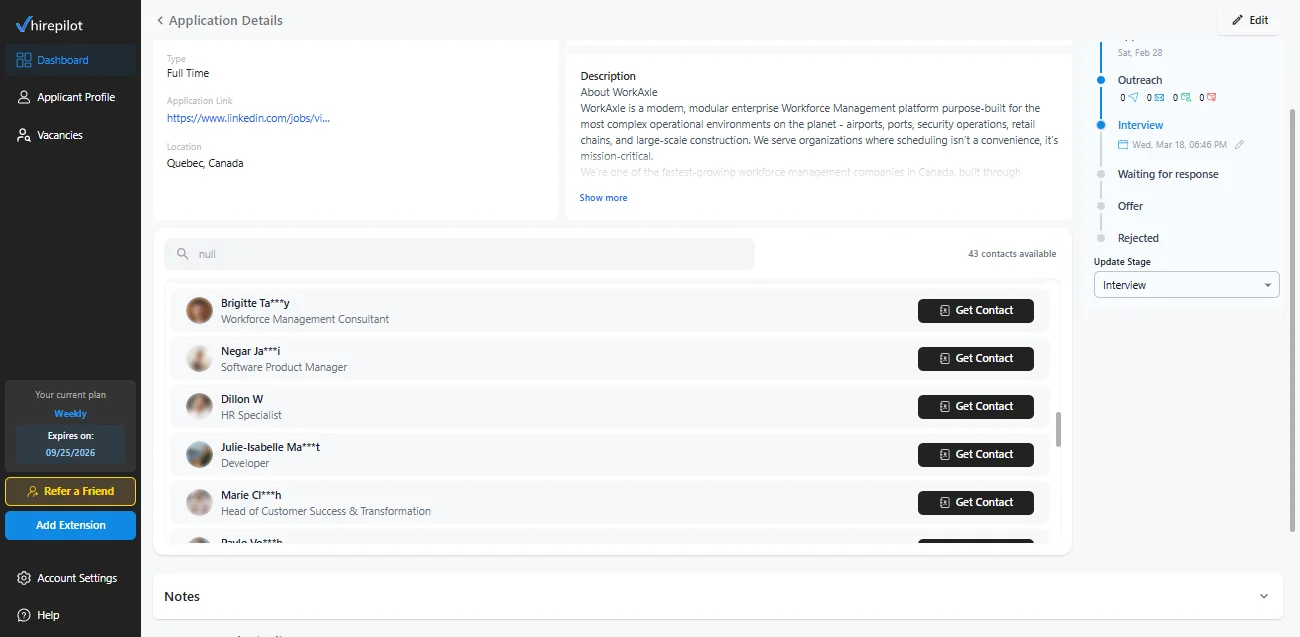
The candidates landing interviews are not necessarily sending more applications. They are doing something different at the point of contact. They are reaching the hiring manager directly, before the resume goes into a system where it competes with 241 other profiles.
Direct outreach to the person who actually makes the hiring decision changes the context of your application. You are no longer an entry in a database. You are a person who took the time to find the right contact, write a relevant message, and show genuine interest in a specific role. That shift alone can move you from the pile to a conversation. This is exactly what a personalized AI recruiter outreach strategy enables when it is done right.
This is also why timing matters. When you apply within 24 hours of a posting going live, you enter a smaller pool. Most job postings are still in early review during that window. Applying fast and following up directly gives you the best possible conditions for being seen.
If you are still applying through job boards alone and waiting, you are playing by the old rules in a new market.
What skills-based hiring means for your resume
One structural shift in 2026 that works in job seekers' favor: degree requirements are falling. According to Robert Half's March 2026 labor market analysis, approximately 85% of employers now use skills-based hiring practices, a significant increase from previous years.
What this means practically is that your resume needs to show what you can do, not just where you studied or what titles you held. Hiring managers are looking for proof of capability: specific outcomes, quantified results, and demonstrated skills tied to the actual requirements of the role.
Generic language works against you. A resume that reads like a job description, with phrases like "led cross-functional initiatives" or "drove results," does not differentiate you in a market where every other applicant is using similar language, often generated with the same AI tools.
Specificity is the new competitive advantage. One concrete result with numbers attached beats three vague bullet points every time. If your resume needs a deeper overhaul for ATS compatibility, the section on ATS keywords and resume examples for 2026 covers exactly which signals the systems are looking for.
The remote work question
Hybrid remains the dominant model for remote-capable roles. Gallup data shows 52% of eligible workers are in hybrid arrangements, 26% are fully on-site, and the remainder are fully remote. But the picture varies significantly by company and sector.
Some high-profile companies have pushed return-to-office mandates in 2026. Others have moved in the opposite direction. The trend is not uniform. If remote or hybrid flexibility is a priority for your search, pay close attention to company-specific policies rather than assuming industry-wide norms.
For job seekers, the practical implication is that remote roles attract even more applicants than on-site roles. When you apply to a remote position, you are competing with qualified candidates from every geography, not just your metro area. Targeting on-site or hybrid roles in your city sometimes means less competition for the same level of role.
What actually works right now
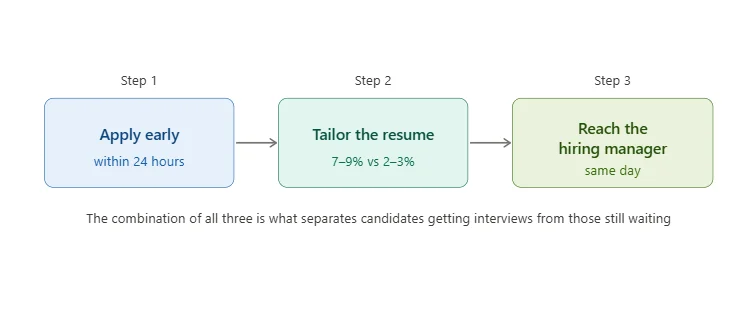
Three things are consistently separating the candidates who are getting hired from those still waiting.
The first is applying early. Jobs posted within the last 24 hours have fewer applicants and higher recruiter attention. Applying to fresh listings before the volume builds gives you a structural advantage that no amount of resume polishing can replicate later.
The second is tailoring the application. Resumes aligned specifically to the job description convert at 7-9%, compared to 2-3% for generic submissions. That difference compounds across 50 applications.
The third is reaching the hiring manager directly. Most candidates apply and wait. The ones getting interviews apply and act. Sending a brief, relevant message to the person behind the role, on the same day you submit your application, puts a face on your file before it enters any screening system. A full breakdown of how this fits into a modern job search is covered in this guide on AI outreach strategies for 2026.
What to watch in the second half of 2026
Most labor economists expect the market to improve in the second half of the year. J.P. Morgan's chief U.S. economist has pointed to potential rate cuts and the effect of recent tax changes as factors that could support hiring activity later in 2026. GDP growth is expected to hold near 1.8%, which is modest but not contractionary.
The risk of recession is still estimated at roughly one in three, which is a real number but not a probable outcome. The more likely scenario is a gradual loosening of conditions over the next several months, with hiring picking up in sectors that have been cautious.
What that means for active job seekers: the market you are navigating right now may be the hardest point in the current cycle. Adjusting your strategy to match the conditions in front of you, rather than the conditions from two years ago, is what determines how long your search takes.
The job market is not broken. It is different. And different requires a different approach.
Start with what you can control today
If your applications are disappearing into silence, the problem is almost never your qualifications. It is the method. You are competing at the bottom of a funnel that was designed to handle too many people at once.
The candidates finding traction in 2026 are applying fast, targeting their materials, and making direct contact with the right person. That is the complete picture. Not one of those three things alone. All three, working together.
HirePilot was built around exactly this workflow: autofill so you apply faster, a job tracker so nothing falls through, and direct outreach to the hiring manager so your application does not stop at the form. If you want to see how the full strategy comes together, this breakdown of job search strategies that actually get results in 2026 lays it out in one place.
If your search feels stuck, that is where to start.
FAQ: Job market right now
How is the job market right now?
Competitive, but not collapsing. The unemployment rate is 4.3% as of March 2026, which looks stable on paper. But the hiring rate dropped to its lowest since April 2020, and the average job posting now receives 242 applications. The market is still moving, just much more slowly and selectively than it was two or three years ago. If your search feels harder than expected, the data backs that up.
What is the current job market like for job seekers?
The current job market favors candidates who apply early, tailor their materials, and make direct contact with hiring managers. Generic applications to crowded job boards convert at 0.1-2%. Volume alone is not a strategy anymore. The job seekers landing interviews are the ones treating each application as a targeted effort, not a numbers game.
Why am I not hearing back from applications?
The most common reason is volume, not qualification. The average job posting now receives over 240 applications, and most are filtered by ATS software before a recruiter ever sees them. If your resume is not closely matched to the job description in terms of keywords and format, it may be screened out automatically. Applying early, tailoring your resume, and following up directly with the hiring manager each improve your chances significantly.
Which industries are hiring the most right now?
As of early 2026, health care, construction, transportation, and social assistance are seeing the most consistent job growth. Technology hiring is uneven, with strong demand for AI-related roles but more competition in general software engineering. Financial services and professional services also show active hiring in specific functions.
Does applying on the first day really matter?
Yes, timing has a measurable impact. Roles posted within 24 hours have fewer applicants and more active recruiter attention. The shortlist is often assembled early in the posting window. Applying to new listings quickly and pairing that with direct outreach gives you the best conditions to be seen before the volume builds.
Should I keep applying to more jobs or slow down and target fewer?
The data favors targeted over volume. Generic applications convert at 2-3%. Tailored applications aligned to specific job descriptions convert at 7-9% or higher. Job seekers who focus on quality and add direct outreach as a second step typically need fewer applications to land interviews than those relying on high-volume strategies.
Find your next job faster - without the chaos
Spend minutes, not hours, on applications. Stay organized, follow up confidently, and get noticed sooner.
Share this article

Viktor Shumylo
Viktor Shumylo is the co-founder of HirePilot, an AI-powered job search platform. He has 10+ years of experience building SaaS products and tools that help job seekers optimize resumes, streamline applications, and land interviews faster.
More articles by Viktor Shumylo