


Search for skills to put on a resume and you get lists of 10, 25 or even 300 options. They tell you what exists, not what the job in front of you is asking for. The best skills for a resume are the ones a specific posting names and you can prove, written in the posting's own words.
That makes a skills list something you adjust for every application, not something you write once.
Hard skills, soft skills and tools: what counts as a resume skill
Most resume skills fall into three groups.
Hard skills are abilities you learn and can show with a result: financial modeling, keyword research, bookkeeping, paid social campaigns. A recruiter can check them in a test, a portfolio or a follow-up question.
Soft skills describe how you work with people and problems: communication, teamwork, problem-solving, time management. Everyone claims them, so they only carry weight next to an example.
Tools are the software and platforms you use to do the job: Excel, Salesforce, QuickBooks, Google Analytics 4, Jira. List them separately, because a posting often names the exact tool and a recruiter searching the pool types that name.
The hard skills vs soft skills question on a resume has a simple answer. Put hard skills and tools in your skills section, where they can be scanned. Show soft skills in your experience, where a bullet like "trained four new hires on the returns process" proves teamwork and communication better than the words themselves.
What skills do employers look for?
The National Association of Colleges and Employers (NACE) surveys employers about the new college graduates they plan to hire. In its Job Outlook 2026 Spring Update, 163 employers named the skills they look for on new graduates' resumes:
| Skill | Share of employers |
|---|---|
| Ability to work in a team | 85% |
| Problem-solving skills | 82% |
| Communication skills (verbal) | 78% |
| Technical skills | 73% |
| Communication skills (written) | 72% |
| Strong work ethic | 71% |
| Analytical or quantitative skills | 70% |
More than half of the employers in that survey named 10 or more skills, and NACE adds that listing skills is not enough. Employers want to see examples.
Two things follow from this. Teamwork, problem-solving and communication are what nearly every employer wants, so they belong in your bullets as proof. Technical skills are the ones that change from job to job, so the posting decides which of them go on your list. Which technical skills count depends on your field, and the keywords recruiters search for in your industry show the same pattern across job descriptions.
How to find the skills a job is asking for
Read the requirements and the responsibilities, not just the job title. Two "marketing specialist" roles can ask for very different things, one for paid ads and reporting, another for content and social media.
Go through the posting and mark three kinds of words:
- Tools and platforms by name, such as Looker Studio, HubSpot or QuickBooks.
- Hard skills, such as remarketing, local SEO or month-end reconciliation.
- Phrases that hide a skill, such as "managing successful social media campaigns" or "improving reporting processes".
Anything that appears more than once, or in both the requirements and the responsibilities, is a priority. NACE notes that many employers put the key skills for the position right into the job description, so the posting is your best source.
To see what a whole occupation usually requires, O*NET OnLine, the US Department of Labor's occupation database, lists the skills and software for each job. It is a good check when you change fields. The same reading of the posting is the first step when you tailor your resume to the job description.
What a real job match shows: one resume, three job postings
We ran one real resume, from a growth marketer on our team, through HirePilot's resume match on three real postings on Indeed: a paid media and performance marketing specialist, a digital marketing specialist and an SEO and AI search specialist. Each run compared the resume with the posting and split the job's key skills into two lists, "in your resume" and "missing". The match score is the share of those skills the resume already shows.
| Job posting | Skills in the resume at first | Match after adding skills she really has |
|---|---|---|
| Paid media and performance marketing specialist | 6 of 18 (33%) | 18 of 18 (100%) |
| Digital marketing specialist | 7 of 15 (47%) | 14 of 15 (93%) |
| SEO and AI search specialist | 7 of 16 (44%) | 16 of 16 (100%) |
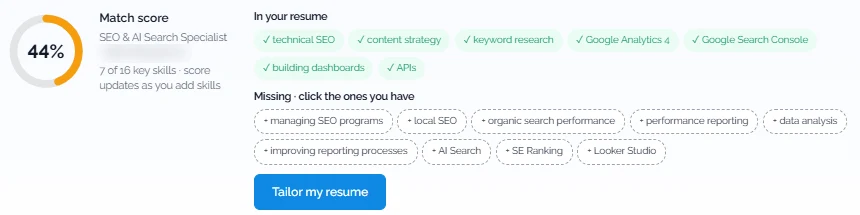
The scores looked low, but the gap was not experience. Take the SEO posting. Of the nine skills listed as missing, five were in the resume under different names than the posting used. "Performance reporting" was there as an SEO dashboard built on Search Console and GA4 data. "Organic search performance" was there as a line about growing a site's organic search traffic. The other four, local SEO, AI search, Looker Studio and SE Ranking, were skills she uses but had never written down.

AI search skills came up twice. The digital marketing posting asked for AEO, GEO and AI search, and the SEO posting asked for AI search by name. If you already optimize content for AI answers, write it down in the terms postings use.
One skill stayed unchecked. The digital marketing posting asked for TikTok, she has not run TikTok campaigns, so it stayed off the resume and the score stopped at 93%. A skill you cannot talk about in an interview costs more than a lower score.
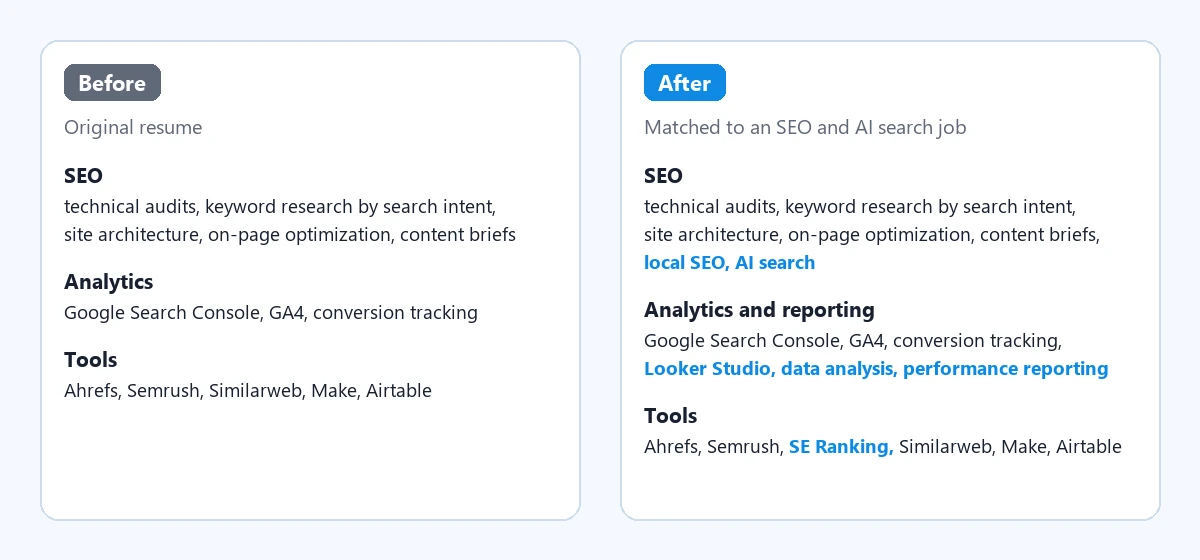
Here are the skills from that run, regrouped into labeled lines the way the next section suggests, with the added skills in blue. Nothing in the after version is new experience, only skills she already had, named the way the posting names them.
"A low match score rarely means you are the wrong person for the job. Most of the time the posting describes your work in words you have never used, or names a tool you use every week and never listed. Close those gaps first. The skill you have never used is the one to leave out." Viktor Shumylo, co-founder, HirePilot
You can run the same test on any posting: paste the job link, upload your resume and check which of the job's skills your resume is missing before you apply.
How to write your resume skills section
The skills section usually goes after the summary or after work experience. Put it higher if the role is technical and the tools matter most, lower if your experience tells the story better.
Here is how to list skills on a resume and how to add skills to your resume so a recruiter, and the software they use, can match them to the posting:
- Group the list. Use short labeled lines such as "SEO", "Analytics", "Tools" and "Languages" instead of one long paragraph.
- Use the posting's words. If the job says "performance reporting", write that, not only "dashboards".
- Write the full name and the short form once when the term has both, for example "search engine optimization (SEO)".
- Keep it to what you can prove. Every skill on the list should have a bullet in your experience or a project you can describe.
- Repeat the most important skills in your experience. "Built a weekly performance report in Looker Studio for 3 product lines" shows the skill, the tool and a result in one line.
An applicant tracking system copies your resume into fields a recruiter searches, so a clean one-column layout and standard section names help it read your skills list correctly. The rules that make your resume readable for an ATS apply to this section too.
Before you send any application, reread the full resume, including every line you changed for this job. Each sentence should be something you can explain in an interview.
Examples of skills to put on a resume by job
These examples come from O*NET OnLine. The tools are from its software list for each occupation, and the skills are from its lists of essential and transferable skills for the job. Use them as a starting point, then match the list to the posting.
| Job | Tools O*NET lists | Skills |
|---|---|---|
| Marketing specialist | Google Looker Analytics (Looker Studio), Tableau, Salesforce, Asana | Critical thinking, writing, persuasion, systems evaluation |
| Customer service representative | Salesforce CRM, Microsoft Access, Intuit QuickBooks, Slack | Active listening, speaking, service orientation, negotiation |
| Project management specialist | Atlassian Jira, Asana, Tableau, Salesforce | Judgment and decision making, coordination, time management, management of personnel resources |
| Bookkeeping clerk | Intuit QuickBooks, Sage 50 Accounting, SAP Concur, Microsoft Access | Mathematics, active listening, critical thinking, time management |
| Data analyst (O*NET: data scientists) | Python, Microsoft Power BI, Microsoft Excel, Google Looker Analytics | Mathematics, critical thinking, complex problem solving, programming |
A posting will be more specific than any occupation profile. A project manager role in construction may ask for Procore, one in software for Jira, so the posting still decides.
Mistakes to avoid when listing skills
- Listing skills you do not have. Recruiters ask about them, and some roles test them.
- Generic words with no proof. "Hard-working" and "detail-oriented" say little on their own. Show them in a bullet instead.
- Outdated tools you last used years ago make the whole list look old.
- A list of 30 items. A long list hides the five skills that matter for this job.
- Copying the whole job description. Pasting the posting into your resume or stuffing every term into the skills section looks like a trick to anyone who reads it.
FAQ: Skills on a resume
How many skills should you put on a resume?
There is no fixed number. List the skills the posting asks for that you can prove, plus the tools you use for the work. If a skill does not help you get this job, leave it for another application.
Should you list soft skills on a resume?
Yes, but show them more than you list them. Employers in NACE's 2026 survey ranked teamwork, problem-solving and communication highest, and they want examples, so put soft skills in your experience bullets with a result.
Does a resume need a separate skills section?
For most roles, yes. A short skills section lets a recruiter see in seconds whether your skills match the posting, and it gives an applicant tracking system a clear place to find the terms a recruiter searches for.
What skills can you list with little experience?
List skills from classes, projects, internships, volunteer work and part-time jobs, plus the software you know. NACE research finds that employers often choose the candidate with internship experience when two candidates are otherwise equal, so describe what you did there in detail.
How do you add software skills to a resume?
Give them their own labeled line, such as "Tools", and write each name the way the posting does. Add a level only if the posting asks for one, for example "Excel (advanced)". Then show the main ones at work in your experience, for example the report you built or the process you ran with them.
Check one job against your skills today
Pick one posting you want to apply to this week. Mark its tools, hard skills and skill phrases, find the ones you already have under other words, and update your skills section and two bullets in your experience. Then run the resume against the posting in HirePilot's free resume match to see what is still missing.
HirePilot also fills LinkedIn Easy Apply, Indeed and Workday applications from your profile for you to review and keeps every application in one tracker. Start for Free with a 7-day trial.
Find your next job faster - without the chaos
Spend minutes, not hours, on applications. Stay organized, follow up confidently, and get noticed sooner.
Share this article

Viktor Shumylo
Viktor Shumylo is the co-founder of HirePilot, an AI-powered job search platform. He has 10+ years of experience building SaaS products and tools that help job seekers optimize resumes, streamline applications, and land interviews faster.
More articles by Viktor Shumylo