

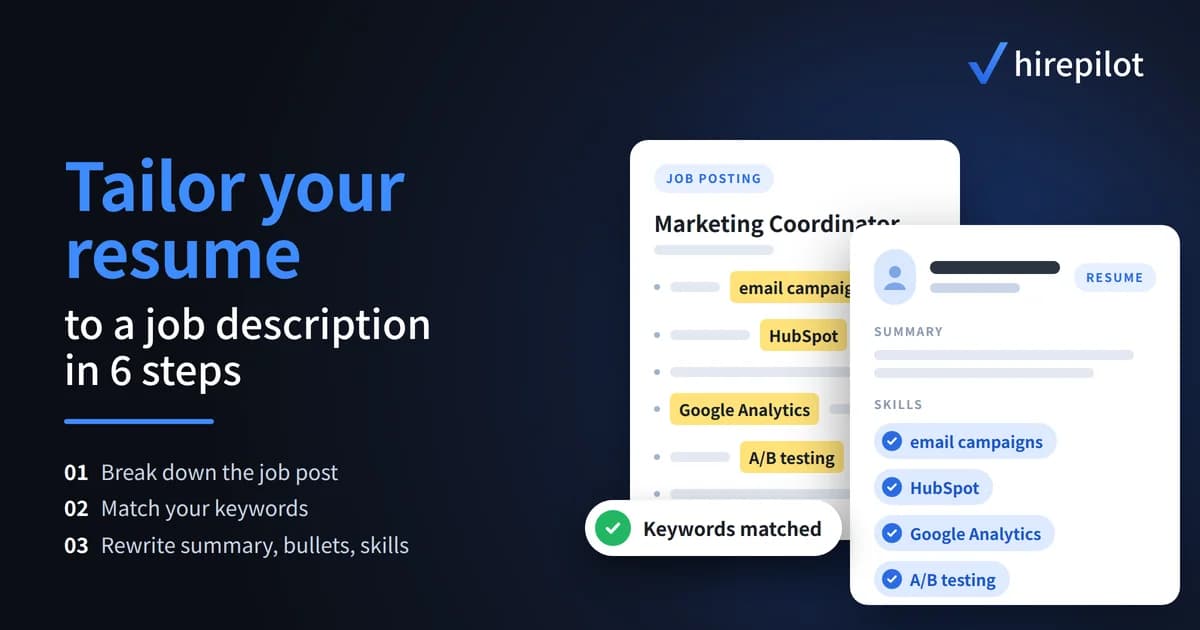

If you're wondering how to tailor your resume to a job description, focus on three sections: your summary, your top experience bullets, and your skills. Match them to the keywords and priorities of one specific posting, using only experience you really have. With a base resume ready, it takes 10 to 30 minutes per application.
Tailoring matters because software usually reads your resume first, and then a recruiter skims it for a few seconds. A strong but generic resume loses on both counts, which is why dozens of applications can bring almost no replies.
Below: a master resume to work from, six steps with before-and-after examples for the summary, bullets, and skills, a full side-by-side example, a way to tailor faster when you apply to many jobs, and a checklist to reuse every time.
What does it mean to tailor a resume to a job?
Tailoring a resume means presenting your real experience in the language of one specific job posting. You don't invent skills or inflate titles. You choose which achievements to show first, which words to use for them, and what to leave out.
A job description is the employer's list of what the role involves and who they want for it: duties, required skills, tools, and preferred qualifications. Think of it as the answer key. Your job is to show, honestly, where your background matches it.
Most employers read your resume through an applicant tracking system (ATS) first. An ATS is software that stores applications and lets recruiters search and rank candidates by keywords, such as skills, job titles, and certifications. If the posting says "customer onboarding" and your resume says "helping new clients get started," a person might connect the two. A keyword search often won't.
A tailored resume closes that gap. Same career, same facts, sharper match.
Should you tailor your resume to every job?
Yes, for every role you actually want. Most hiring now starts in software, and the numbers make the case for why you should tailor your resume to the job each time.
- Most employers screen with software. In the 2021 Harvard Business School and Accenture study Hidden Workers: Untapped Talent, 63% of employers surveyed in the US, UK, and Germany used a recruitment management system to handle hiring.
- That software makes the first cut. More than 90% of those employers relied on it to filter or rank applicants first: 94% for middle-skills roles and 92% for high-skills roles.
- The human scan is short. In a 2018 eye-tracking study by Ladders, recruiters spent an average of 7.4 seconds on the initial screen of a resume.
So your resume has to pass a keyword search and then make its case in a few seconds. A generic version struggles with both.
That doesn't mean a full rewrite for every application. Job seekers on Reddit and career forums keep landing on the same compromise: keep one strong base resume per type of role, then make targeted edits for each posting. Learning how to tailor a resume to a job this way keeps the effort small and the match high.
"Most people who come to HirePilot have the experience but not the exact words the employer is searching for. A tailored resume doesn't change your story. It retells it in the language of that one job." Viktor Shumylo, co-founder, HirePilot
Before you start: build a master resume
A master resume is one private file that holds everything you've done: every job, project, tool, certification, metric, and win. It can run four or five pages. Nobody sees it but you.
The master resume solves the hardest part of tailoring, which is remembering what you did. When a posting asks for "vendor management," you don't have to dig through old emails at midnight. You open the master file, find the bullet about renegotiating three supplier contracts, and copy it into your tailored version.
To build one, list each role with 8 to 12 bullets instead of the usual 3 to 5. Add numbers wherever you have them: budgets, team sizes, percentages, deadlines. Keep a separate list of every skill and tool you've used at work.
Update it once a month or after any big project. Twenty minutes of upkeep saves hours later.
How to tailor a resume for a specific job in 6 steps
The six steps below take 10 to 30 minutes once your master resume exists. The first few times will take longer, and that's normal. Each step builds on the last, so follow them in order.
Step 1. Break down the job description
Read the posting twice. The first time, read it like a candidate. The second time, read it like the recruiter who will search the ATS.
Most postings have three parts: requirements (must-haves), responsibilities (what you'll do), and preferred qualifications (nice-to-haves). From each part, pull out four kinds of job description keywords:
- Hard skills, such as email marketing or financial modeling
- Tools and software, such as HubSpot, Salesforce, or Excel
- Action verbs, such as launch, manage, or analyze
- Numbers, such as years of experience, budget size, or team size
Pay the most attention to the first three to five bullets in each section. Employers usually list what matters most at the top. In the short sample posting below, the keywords are marked in bold:
Marketing Coordinator, B2B SaaS
You will plan and launch email campaigns, manage our HubSpot workflows, and report on campaign performance to the marketing lead. You'll also support content calendars and social media scheduling.
Requirements: 2+ years in B2B marketing, hands-on HubSpot experience, strong Google Analytics skills. Preferred: A/B testing, basic HTML for email.
Notice that HubSpot appears twice. Repetition is a signal that a skill matters.
Step 2. Compare your resume and find the gaps
Put the posting next to your current resume and make two lists. The first list holds keywords you already have. The second holds keywords that are missing.
For each missing keyword, ask one question: have I actually done this? If yes, find the proof in your master resume and bring it in. If no, leave it out. A tailored resume only reframes real experience. It never adds work you didn't do, because an interviewer will ask about it.
For the sample posting, a candidate might already have "email campaigns" and "Google Analytics" but be missing "HubSpot," "A/B testing," and "campaign performance" in exact words, even though they've done all three.
Step 3. Rewrite your resume summary
The summary is the first thing a recruiter reads, so it carries the most weight in those few seconds. Keep it to three or four sentences built from three parts: the job title from the posting, your strongest relevant result, and two or three key skills from the job description.
Before
Motivated marketing professional with experience in digital channels. Creative team player looking for a new challenge in a growing company.
After
Marketing coordinator with 3 years in B2B SaaS. Planned and launched 40+ email campaigns in HubSpot, lifting open rates from 21% to 29%. Skilled in Google Analytics reporting, A/B testing, and content calendar management.
The second version names the role, proves a result, and matches five keywords without sounding forced.
Step 4. Reorder and rewrite your experience bullets
Most of the match happens in your experience bullets. Start with the order: in each role, move the bullets most relevant to this posting to the top. Recruiters skim, so the top bullets matter most.
Then rewrite the bullets in the posting's language. Use a simple formula of action, context, and result: what you did, where or with what, and what changed. Add a number whenever you can.
Before
Responsible for newsletters and helping with the company blog.
After
Launched a biweekly HubSpot newsletter for 12,000 subscribers and ran A/B tests on subject lines, raising click-through rate by 18% in two quarters.
The facts didn't change. The words now match what the employer searches for, and the result shows the impact.
Step 5. Match your skills section to the job
The skills section is where an ATS keyword match is easiest to win or lose. Use the exact terms from the posting when they honestly describe what you can do. Put the most important skills first and remove the ones that don't matter for this role.
Before
Skills: Marketing, social media, Microsoft Office, teamwork, Photoshop, event planning
After
Skills: HubSpot, email marketing, Google Analytics, A/B testing, campaign reporting, content calendars, social media scheduling, basic HTML
Soft skills like teamwork belong in your bullets, where you can prove them, not in a list.
Step 6. Proofread and check the match
Open the posting and your tailored resume side by side one last time. Check that the top keywords from Step 1 now appear in your summary, your first bullets, and your skills section.
Then check the basics. Fix typos and make sure job titles, dates, and company names are correct. Save the file as a PDF unless the posting asks for Word, and give it a clear name, such as Name-Company-JobTitle-Resume.pdf. A file called resume_final_v7.pdf tells the recruiter you send the same thing everywhere.
Tailored resume example: before and after
The full example below covers a Customer Success Manager role at a SaaS company. The posting asks for customer onboarding, retention and churn reduction, QBRs (quarterly business reviews), Salesforce, Gainsight or a similar CS platform, and upsell experience.
The candidate has done all of this. The generic version just doesn't say so in the employer's words.
| Section | Generic resume | Tailored resume |
|---|---|---|
| Summary | Customer-focused professional with strong communication skills and a passion for helping clients succeed. | Customer Success Manager with 4 years in B2B SaaS. Owned a $1.2M book of 45 accounts and cut churn from 11% to 6%. Skilled in onboarding, QBRs, and Salesforce. |
| Bullet 1 | Worked with clients to answer questions and solve problems. | Led onboarding for 45 mid-market accounts, reducing average time to first value from 30 to 18 days. |
| Bullet 2 | Held regular meetings with customers. | Ran quarterly business reviews with 20 key accounts, which surfaced expansion needs and drove $180K in upsell revenue. |
| Bullet 3 | Kept records of customer accounts. | Tracked account health in Salesforce and flagged at-risk clients early, raising renewal rate to 94%. |
| Skills | Communication, Microsoft Office, problem solving, teamwork | Customer onboarding, churn reduction, QBRs, Salesforce, account health scoring, upselling, renewals |
| Keywords matched | 1 of 7 | 7 of 7 |
| Likely result | Low rank in an ATS search, unclear fit in a 7-second scan | Shows up for core keyword searches, fit is obvious from the summary alone |
Nothing in the tailored column is invented. Every number already lived in the candidate's master resume. The only change is which facts come first and which words describe them.
Common mistakes when you tailor your resume
Most tailoring mistakes come from doing too much in one place or too little everywhere else. Watch for these five.
- Keyword stuffing. Repeating "project management" eight times or hiding keywords in white text doesn't fool anyone. Recruiters notice it, and it makes your resume hard to read. Use each key term where it naturally fits, usually two or three times.
- Changing only the skills section. A skills list full of the right keywords, with bullets that never mention them, looks thin. The experience section is where you prove the skills are real.
- Inventing experience. Adding a tool you've never used might get you past the first filter. It will also get you caught in the first interview. Tailor how you describe your work, not the work itself.
- Copying the posting word for word. Mirroring key terms is smart. Pasting entire sentences from the job description makes your resume sound like the job ad, not like you.
- Sending one resume to every job. Tailoring exists to fix exactly this mistake. Even two similar roles at different companies often stress different skills.
How to tailor your resume faster when you apply to many jobs
If you apply to 10 or more jobs a week, 30 minutes each adds up fast. The goal is to keep the match high while cutting the time per application to 10 or 15 minutes.
Keep two or three base versions. Most job seekers target a few related role types, such as "marketing coordinator" and "email marketing specialist." Build one base resume for each. Then you start every application most of the way done instead of from zero.
Change only the top third. This rule saves the most time. The summary, the first two or three bullets of your latest role, and the skills section carry most of the weight in a quick scan. Tailor those for every job and leave the rest alone unless the posting asks for something deeper.
Use AI chatbots to find gaps, then check every fact. Paste a posting and your resume into ChatGPT or Claude and ask which keywords are missing. AI is fast at spotting gaps and suggesting phrasing. It is also known to add skills, metrics, or titles you never had, so verify every line before you send. Copy this prompt to start:
Compare my resume with the job description below.
1. List the important keywords, skills, and tools from the job description that are missing from my resume.
2. For each missing keyword, check whether my resume already shows related experience. If it does, suggest a rewritten bullet that uses the keyword.
3. Do not add any skill, tool, job title, number, or achievement that is not already in my resume. If a keyword has no match in my experience, write "No match" instead of inventing one.
Job description:
[paste the job description]
My resume:
[paste your resume]
Try a dedicated AI tailoring tool. These tools compare your resume with the posting and point out what to strengthen, so you skip the manual side-by-side. The same rule applies: you approve every change. When you want that comparison in one place, you can tailor your resume to a job description with HirePilot, which compares your resume with the job posting and shows what to bring forward.
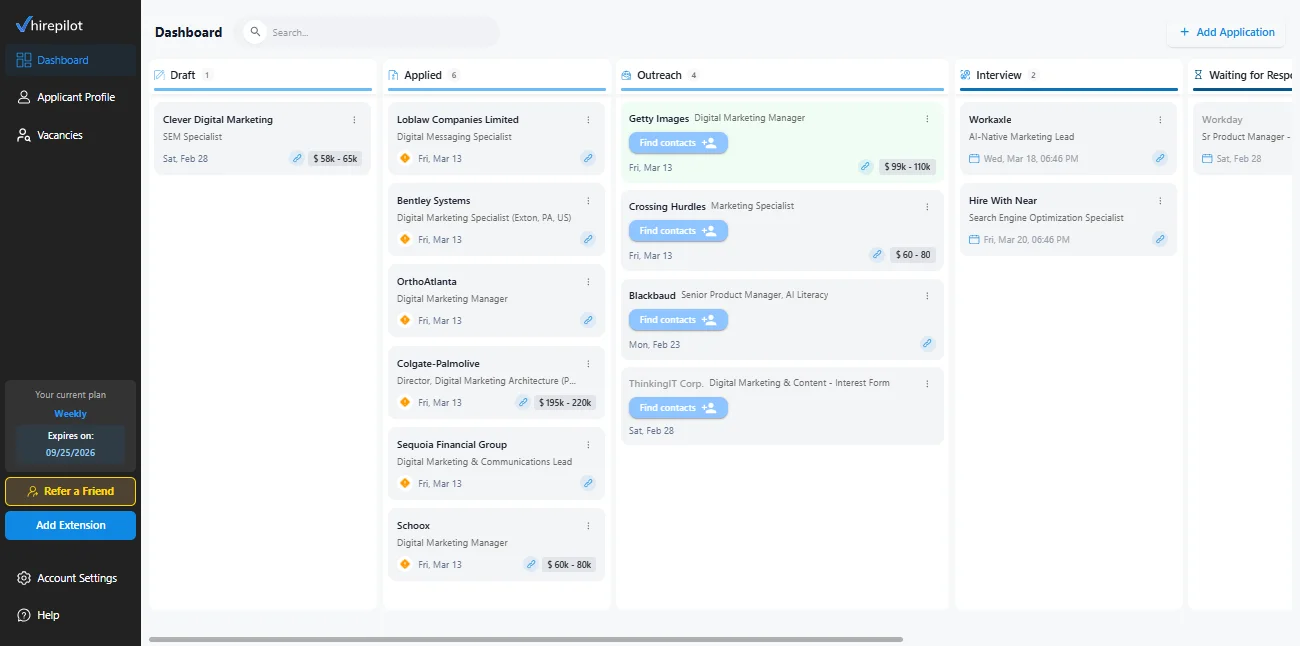
Keep every application in one place. After 30 applications, it's easy to forget where you applied and what stage each one is at, and that hurts when a recruiter calls. HirePilot's Job Tracker keeps every saved job on one Kanban board, and you update each status yourself. To organize your job applications and know which resume went where, name each tailored file by company and role, such as Name-Company-JobTitle-Resume.pdf. Jobs you save from the HirePilot Job Board land on the same board, and you can autofill job applications on LinkedIn, Indeed, and Workday instead of retyping the same fields. You still review and submit each application yourself. AI Recruiter Outreach then helps you find the right contact at the company and send a message after you apply.
Tailored resume checklist
Save this list and run through it before every application. It covers how to tailor your resume to a job in the order that matters most.
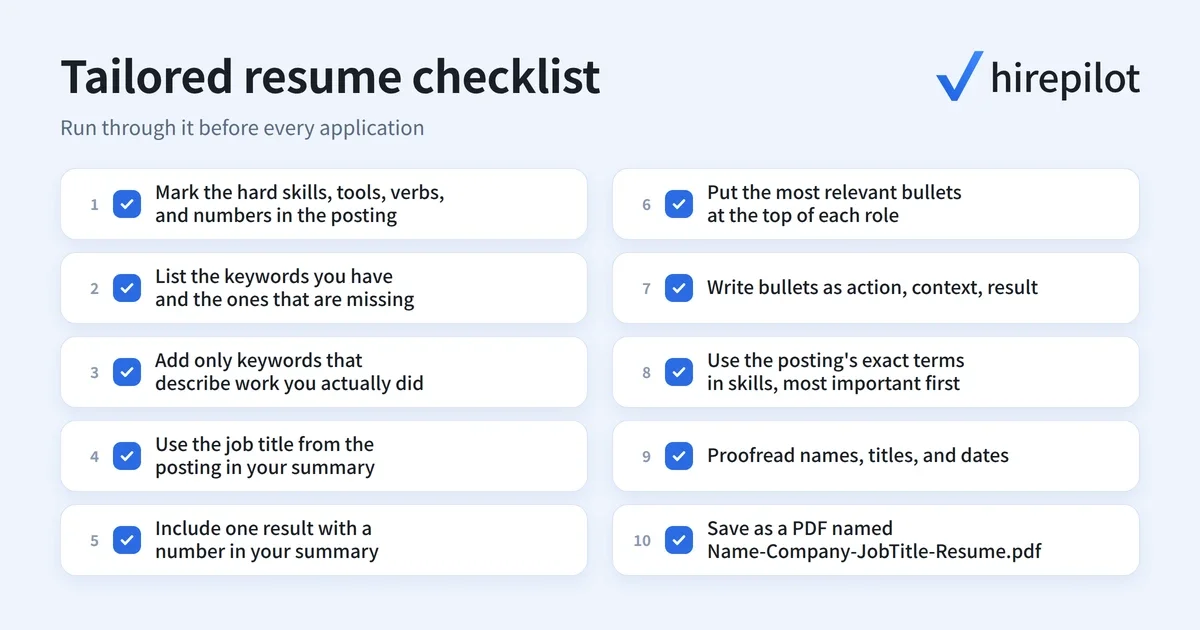
- ☐ Mark the hard skills, tools, verbs, and numbers in the posting
- ☐ List the keywords you have and the ones that are missing
- ☐ Add only keywords that describe work you actually did
- ☐ Use the job title from the posting in your summary
- ☐ Include one result with a number in your summary
- ☐ Put the most relevant bullets at the top of each role
- ☐ Write bullets as action, context, result
- ☐ Use the posting's exact terms in skills, most important first
- ☐ Proofread names, titles, and dates
- ☐ Save as a PDF named Name-Company-JobTitle-Resume.pdf
FAQ
How long does it take to tailor a resume?
With a ready base resume, tailoring takes 10 to 30 minutes per job. Your first few tries will take longer, but the process speeds up once you know where to look.
Where do I start if I don't know how to tailor my resume to a specific job?
Start with the job description, not your resume. Mark the skills, tools, and numbers it asks for, then compare that list with what your resume already says.
How do I get ChatGPT to tailor my resume to a job description?
Paste the job description and your resume, then ask it to list missing keywords and suggest rewrites using only facts from your resume. Use the prompt above as a template and check every line before you send.
Should I tailor my resume for each job?
Yes, but you don't need a full rewrite. Start from a strong base resume for the role type and make targeted changes for each posting.
How do I tailor my resume for a career change?
Lead with transferable skills and results, described in the language of the new role. A project manager moving into operations, for example, can stress budgets, vendors, and process improvements.
Is tailoring a resume dishonest?
No. Tailoring is honest as long as you describe real experience in the employer's language. It becomes dishonest only when you add skills, titles, or results that aren't true.
How can I tailor my resume for free?
Follow the six steps above with any free document editor, and use a free AI chatbot to spot missing keywords. A master resume and the top-third rule keep the process fast without paid tools.
Your next application starts with the job description
Dozens of applications with almost no replies is not a verdict on your career. It's usually a sign that one resume is trying to fit every job. Once you know how to tailor your resume to a job description, each application takes a few extra minutes and speaks the employer's language from the first line.
Build your master resume, follow the six steps, and change the top third every time. Then use the time you saved to follow up, and check how long to wait after you apply before you do.
Applying for jobs should not be a full-time job. Start for free with HirePilot and keep every job and its status in one place.
Find your next job faster - without the chaos
Spend minutes, not hours, on applications. Stay organized, follow up confidently, and get noticed sooner.
Share this article

Viktor Shumylo
Viktor Shumylo is the co-founder of HirePilot, an AI-powered job search platform. He has 10+ years of experience building SaaS products and tools that help job seekers optimize resumes, streamline applications, and land interviews faster.
More articles by Viktor Shumylo